Vote? Absolutely! … but online?

I live in a very progressive community – open government initiatives with lots of opportunities for input, long-term and sustainable vision, alignment with the Canadian Index of Wellbeing – all good stuff. I am also very civic minded. From junior and high school student councils, three House of Commons jobs, work in government relations and community involvement – I’ve always been involved in some capacity and have never missed a vote.

I also know that voter turnout in Canada is abysmal, particularly at the municipal level – 34% in my city in 2010 – but as my community introduces online voting, I’m not sure I agree with the approach.

Statistics Canada reports that the #1 reason people did not vote in the 2010 federal election is “not interested’ (27.7% of non-voters), followed by “too busy” (22.9%). If that’s the case, doesn’t the challenge lie in helping people understand the issues and the choices rather than making the exercise of democratic rights akin to ordering a pizza or texting “LOL”?

women voting Canada
Do it for Nellie! Go out and vote
Source: unknown

Call me an idealist but online voting makes me think we’re letting down the suffragettes who fought for women’s right to vote. It makes me think of African-American voter registration drives in the 60’s that were met with extreme, and at times, violent resistance. Even recently, President Obama’s 2013 State of the Union highlighted 102-year old Desiline Victor, a Haitian immigrant who waited three hours in line to vote in Florida only to be asked to return later. And what about people all over the world – today – who show amazing bravery by going to the polls?

People died in the streets of Cairo for democracy in Egypt… and we can’t walk to the local school gym or church basement? Really?

Robert Cialdini’s book Influence explores the science behind commitment. He writes:

Commitments are most effective when they are active, public, effortful, and viewed as internally motivated (uncoerced) (Influence, 2009, p.95).

It’s why people value the outcome of something difficult – like initiations, boot camp, long lines for concert tickets or saving up for something you really want. Cialdini quotes Aronson and Mills (1959) who found “persons who go through a great deal of struggle or pain to attain something tend to value it more highly than persons who attain the same thing with a minimum of effort” (p.78). I’m not suggesting we should deliberately make voting difficult but there should be some effort on our part both because it helps us to value our democratic right and the consistency of behaviour is important for future voter turnout. Let’s face it, voting at any level in Canada is pretty easy.

People also need their own compelling reason to vote – their internal motivation – to cement long-lasting commitment. Based on the research, when people feel engaged as voters, they become more engaged as citizens. That’s the piece that addresses the “not interested” or “don’t feel my vote matters” element of StatsCan’s findings.

In 2014, the Canadian Index of Wellbeing released its Ontario report which revealed this paradox: More Ontarians are interested in politics, more are registering to vote and more believe it’s their civic duty to vote but fewer are actually voting. Their conclusion suggests “The challenge appears to be how to translate their beliefs and interest into action so that they feel they have a greater stake in the future of our province and country (p.28). So let’s tackle that issue for meaningful participation instead of reducing our civic responsibility. There’s a lot to get excited – or pissed off – about. Start there!

Don’t get me wrong. I’m all for maximising the use of technology to debate platforms, share information, spark engagement. But I think it’s important to make an effort to get to the polling place on election day.

Agree? Disagree? Tell me why.  Share your sources. That’s healthy debate and I’m open to learning. I’m also open to the possibility that online voting is a gateway to deeper civic commitment… but I’m not sold.

Whether you agree with me or not on the merits of old-fashioned voting. I hope you will:

  • Participate in Canada’s Democracy Week: September 15-21, 2014
  • Commit to voting in Ontario’s municipal elections on October 27, 2014 (or whenever and wherever you are)
  • Denounce any watering-down of democratic rights in Canada
  • Talk about and demonstrate the importance of voting and democratic engagement in your family so that people see themselves as “voters” and “citizens” with a stake in the game – because they do.
  • Thank a civics teacher.


You can’t just talk trust… you must act

I was reading Simon Sinek’s book “Start with Why” and came to the part that talks about the major levels of the brain.

“The newest area of the brain, our Homo sapien brain, is the neocortex, which corresponds with the WHAT level. The neocortex is responsible for rational and analytical thought and language. The middle two sections comprise the limbic brain. The limbic brain is responsible for all our feelings, such as trust and loyalty. It is also responsible for all human behavior and all our decision-making, but it has no capacity for language.” (p.55-56)

I’ve read about reptilian brain and reaction as opposed to analysis before, but this time the passage made me think about the limited effect of talking about trust – because the part of the brain that can process that “has no capacity for language” – and the critical importance of showing trust, building trust and setting all the right norms.

If you’ve read Twelve Weeks to Trust on this blog you know that I’m a firm believer in tangible mechanisms and processes that build and maintain trust in organisations. They are a tangible signal of how we want people to behave. They are concrete rules and actions that  the neocortex can analyze and understand and that the limbic brain can see in action. The limbic brain train of thought applies equally to inter-personal trust. It’s not enough to say “trust me” — our brain just can’t compute that. You have to show competence and benevolence. People need to feel the trust. And, that trust can drive behaviour and important decision-making.

What do you think about trust and brain science? How to you act to build, maintain or rebuild trust? I’d love to know.

How Star Wars helped me appreciate planning

“Patience you must have my young padawan” - Yoda
“Patience you must have my young padawan” – Yoda

I admit it. I don’t like planning. I find it tedious and I am always itching to do something. I love problems, projects, challenges that can be solved and then you can move on. It’s why I’ve done lots of issues management and crisis communications. When “it” hits the fan, I’m your girl.

However, I realize that the more complex the issue or the organization, flying by the seat of your pants is not always desirable. I get that you have to think strategically about how all aspects of your plan play out with various audiences, across the organization and over time. I get that, as a leader, you need a clear game plan and it helps your team if you’re just a tad more “buttoned down” (was the term in one of my early executive assessments). I just lament that it takes sooooo long. It seems that the more time there is, the more objections people raise. The more details people want included and, in the end, the ruminations don’t always produce a better mousetrap.

Then, last summer, I visited the Star Wars Identities Exhibit at the Canadian Aviation and Space Museum. The exhibit explores howAccolade Communications photo of Star Wars movie model identities are formed through our families, society and our experiences through the Star Wars characters. While that’s the crux of the exhibit, I was struck with the detail in the movie models, the costume sketches and the signage that explained the painstaking character development and costume design. I hadn’t given any thought to the years of planning that go into movies although it makes abundant sense. You can’t exactly show up on a multi-million dollar movie set without having thought of every detail in advance. And when your movie is a sequel – as many complex organizational projects like replacing legacy systems are – you need the full back-story, the full picture of how your decision will play out in the future and its impacts across the organization today.

So, thank you George Lucas. I believe Yoda has taught me to be more patient, more planful, more detailed because sound planning is the beginning of a lasting legacy.

10 ways puzzles are like problem solving

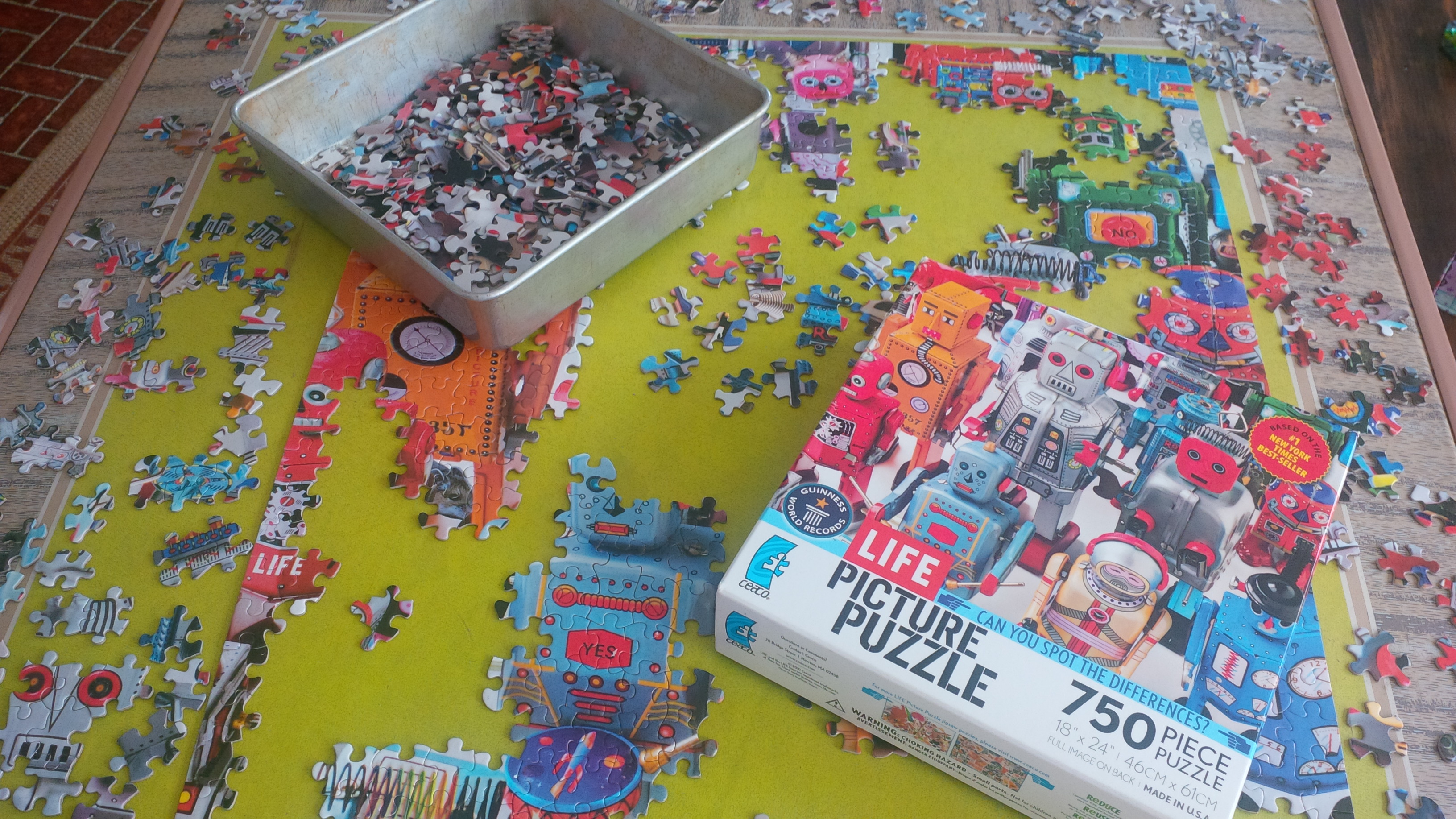
unfinished puzzle

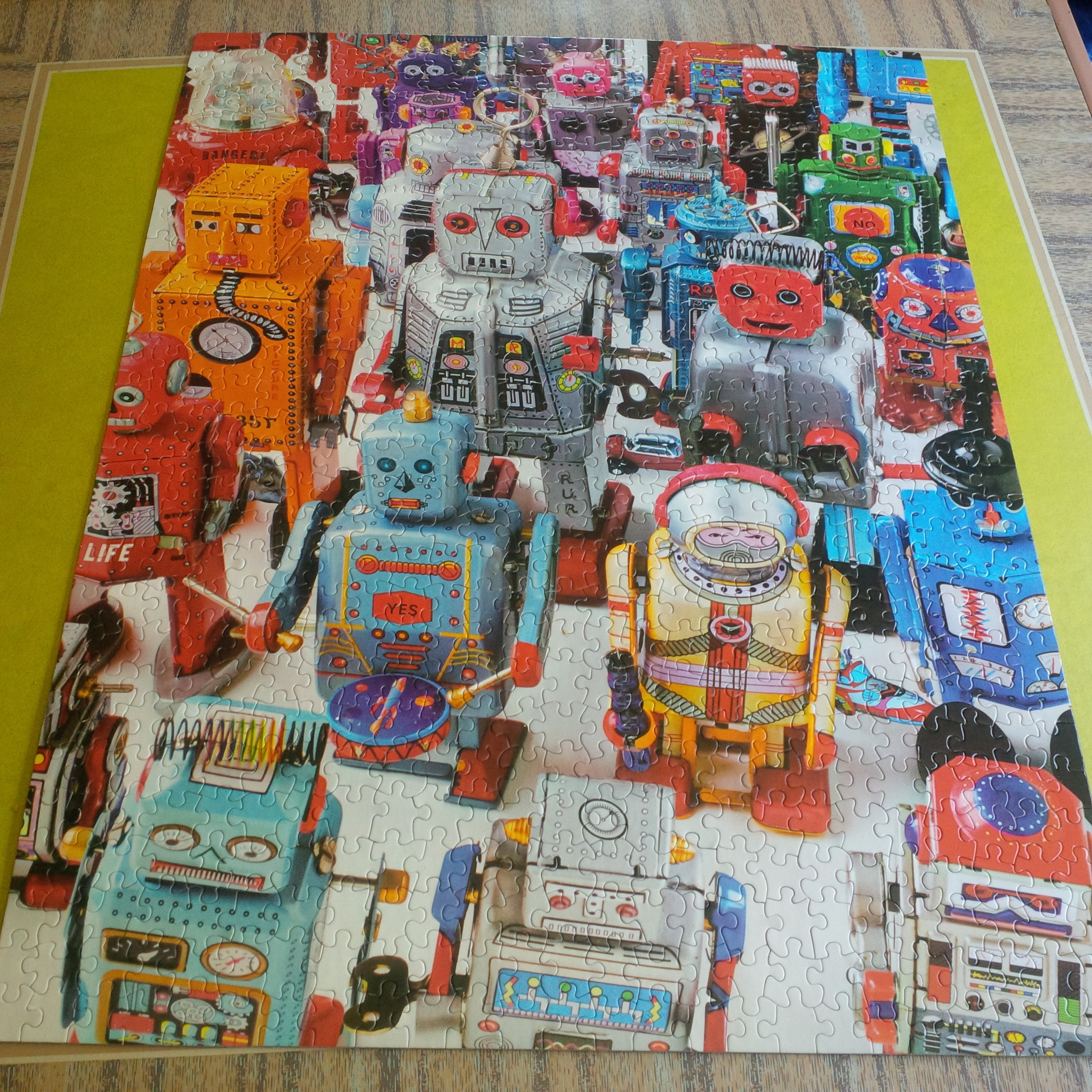
I love jigsaw puzzles. I love doing them with my family at the cottage. I love how excited kids get when they make a connection or put the last piece in place. I love working on them late at night- too late because I just want to find one…more…piece. In this incredibly digital world, what’s the attraction with this hopelessly old fashioned pastime? Is it the satisfaction of completion? Is it the thrill seeing it come together? Yes and yes!

A few weeks ago at the cottage we worked on a puzzle that holds the Guiness Record for being the largest “find the difference” puzzle so there are 71 differences between the image on the box and the puzzle.

As I worked away at it methodically it occurred to me that puzzles are a great metaphor for social and organizational problem solving.

10 things puzzles teach us about problem solving

  1. You start with a view of the big picture.
  2. You establish a frame of reference.
  3. You sort through your “data” and start anywhere you see major similarities. (Quick wins are encouraging.)
  4. It takes time.
  5. Details matter. With close observation you gradually see small details – subtle nuances- in pieces that originally seemed uniform. Where you  thought the sky, snow or forest would  be next to impossible to assemble you see variations in shading. You make new connections.
  6. There are a million ways to solve your puzzle.  They aren’t solved in a linear way. Have you ever started at the top and worked your way down left to right or top to bottom?
  7. Sometimes large pieces fall into place.
  8. You may have to walk away, take a break or change seats to get a fresh perspective.
  9. You need to believe that you can finish.

When we cracked open the puzzle box during our cottage retreat my almost 8-year old daughter asked if I thought we could finish before it was time to pack up and go home. I said: “I’m not  sure. We’ll try.”  My bright girl huffed and said:

10.  “Well, you have to believe you can do it.” Puzzles and problem solving

Indeed! It appears that bit of wisdom applies to broader problems as well. What piece of the puzzle would you like to add to this list?

I hope you’re enjoying your summer.