“Would you please pass the gravy?” or “So, how are things?” are not good conversation starters. You can do better and have a much better time at any holiday when you start having meaningful conversations.
As my gift to you, and to myself, I’m recycling one of my favourite posts. It’s always appropriate and since I wrote it in April 2012, my family has had dozens of great conversations. While meandering through “Which family rule would you change?” to “What is your favourite family tradition?” or “What do you admire about someone at the table?” we’re teaching our kids to participate equally in conversation, to listen to others and that there are no wrong answers.
An innocent “What was your most memorable birthday present?” yielded a particularly rich discussion with my sister at her cottage this summer. It turns out her favourite birthday present was an outing for dinner and a movie alone with my Dad when my Mom was gravely ill. She was eight or so at the time. As an adult now, I can imagine the stress of the situation for my Dad – self-employed, four little girls and a very sick wife – the birthday might have seemed like one more thing to do. So there was nothing fancy, just dinner and a movie; yet the one-on-one time is what is most cherished by my sister. It also sparked a great chat about how few kids movies came out in those days.
 You can have more meaningful conversations too. If you’re short on ideas for questions, the post below has ideas to help. There are even apps for that!
As for me, my collection of questions continues to grow. I keep the deck of family dinnertime questions handy. Now, I am adding more grown-up questions to my repertoire with Chuck Klosterman‘s HYPERtheticals: 50 Questions for Insane Conversations. The back cover asks:
“You are offered a Brain Pill that will make you 10 percent more intelligent, but you will seem 20 percent less intelligent to everyone else. Do you take the pill?”
I can’t wait to crack open the box. I know I’ll learn a lot about people I think I know well.
Wishing you a happy holiday filled with meaningful conversations.
From the archives:
Put down the smartphone and ask a great question
 At a business lunch, I noticed that almost everyone left their phones on the table in front of them. Are they waiting for someone more interesting to call? In a pub on St. Patrick’s Day, at least half the people were holding phones, telling others… what? That they are having such a great time? If that’s true, why don’t they put the phone down and say that to the people in front of them?
I have no objection to texting a friend so they can meet up with you but when you are intent on documenting all your moments for people who are not there, aren’t you missing out on the experience of actually being present, with the people who are there? Or if you are constantly checking your phone to read other people’s Facebook posts, texts, Tweets or e-mails, are you telling the people you are sitting with that you’d rather be elsewhere? Then last week I saw a woman take her iPhone to communion. Seriously…. someone more important than God is going to call, text, Tweet, Facebook or BBM you in the 30 seconds it takes you to walk up there?
Shake it off people! I know it’s our reptilian brain that is easily distracted. It’s the ego that’s fed whenever others respond to your picture, post or Pinterest…. but we are not Pavlove’s Dog. We do not have to react to every flashing light, every beep, every tweet and text.
As my high school French teacher used to say when the bell rang: “Dogs respond to bells. People respond to other people.” So the next time you’re sitting at a lunch, hanging out in a pub or having a meal with friends or family, embrace the opportunity to get to know something new about the people around you, to deepen your relationships and to challenge your assumptions. You can’t do that in a tweet or Facebook post.
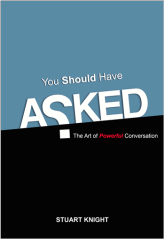
In his book, You Should Have Asked, Stewart Knight recounts how asking “Which Canadian do you most admire?” at a family reunion led to a rich conversation about his father’s immigrant roots and political hero and his mother’s literary tastes – two aspects of his parent’s lives he had completely ignored until that day. His book offers an easy approach to creating powerful conversations by asking good questions. Knight writes:
“With powerful conversations, instead of learning where a person lives, you will discover one of their favourite childhood memories. With powerful conversations, instead of knowing what a person does for a living, you will find out what that person does as a passion. You will discover the intricate and fascinating details of what makes that person who they are” (p.38).
Not only will you benefit from a more interesting discussion and a deeper relationship but, according Robert Cialdini author of Influence: Science and Practice, when you identify something you have in common with another person, that similarity leads to liking, reciprocity, stronger networks and a greater ability to accomplish your personal or professional objectives. Within an organization, research from Ken Blanchard found that connectedness to the leader – the extent to which leaders make an effort to build rapport and personal and professional relationships – leads to greater discretionary effort and higher intent to remain with your organization. Connectedness to colleagues – the extent to which colleagues make an effort to build rapport and personal and professional relationships – is also positively correlated with discretionary effort and organizational citizenship behaviours. So people who feel connected to their co-workers are more apt to go the extra mile at work. Bottom line: there are compelling personal and professional reasons to be fascinated by others, to honour their uniqueness and to ditch the small talk:
1. Ask open ended questions like:
- What do you like most about what you do?
- What led you to this type of work/hobby/pursuit?
- What would you change about your industry/community/legislation/etc?
- What did you want to be when you were a child?
To borrow a few from Knight (and he has a ton of great ones):
- Out of all the jobs in the country, which one do you think would have the most devastating impact on society if those people didn’t show up for work? And what would be the worst day of the year for them to not show up? Why?
- Ask people why they live, work or travel where they do.
2. Listen and build your next question on what you have just heard.
3. Stop worrying that asking questions makes you look like you don’t know anything – you certainly don’t know everything so get over it.
4. Ask how things work, why they are that way, what makes a process so difficult.
5. Embrace the opportunity to learn!
Great questions are the ultimate mobile app so use them wherever you go! After reading Knight’s book, my husband started asking our kids a ‘Question of the Night’ at the dinner table and the conversations are fantastic. It gives the kids a chance to practice listening skills and also to respond to a serious question where there’s no right answer. Our favourites include:
- If you could go anywhere on a family vacation where would we go and why?
- If you had a superpower, what would it be?
- When you are a parent, which rules will you enforce in your home?
- If you could only eat one food for the rest of your life, what would it be?
- Who is your favourite character in a book?

To boost our dinner table topic creativity I recently purchased The Box Girls Family Diner Box of Questions. Try these at home, with friends or at the office or leave the cards out on tables during a party and watch the level of conversation rise! Another great resource (that also comes with a mobile App) is the Story Starter Pack. My favourite question here is : “If you could dig a tunnel from your house to anywhere in the neighbourhood/country/world, where would it go?”
You deserve the gift of more fun, meaningful and memorable conversations and the deeper relationships that result from them. Your co-workers, friends and family deserve to feel worthy of your attention. Try it! You can tell everyone about it on social media…. later. And, please tell me…. what’s your favourite “deep question” ? And what happened the last time you asked one?




 Accolade Communications