
“You get trust if you give trust.” Sound advice from a former Prime Minister

Dominique O'Rourke, PM Paul Martin
Karen Calligan, Prime Minister Paul Martin and I at the University of Guelph’s Lincoln Alexander Outstanding Leader Awards

Only 22 people in Canada’s history have earned the title of Prime Minister. So if one of them gives you advice, I think you should take it. The advice is even more compelling if the Prime Minister has also been a captain of industry, a world-renowned statesman and now a philanthropist dedicated to aboriginal education.

Last Wednesday, I was fortunate enough to join other alumnus and the advisory committee for the MA Leadership at the University of Guelph for a conversation with former Prime Minister Paul Martin who was at the University to receive the Lincoln Alexander Outstanding Leader Award.

What did the man behind eliminating Canada’s deficit, averting a bank crisis and the architect of the Kelowna Accord have to say about leadership? He said that a leader’s ability to listen is the key and he attributed his success as a young business executive to seeking out the people who have the answers.

“If you’re the leader, you always get the last word. You always get to make the decision. It’s up to you to get the best out of everyone so listen until you’ve exhausted all the advice in the room.”

Of course, given the top news items in our country this week: accusations of crack cocaine use by Toronto’s mayor, construction kickbacks in major Quebec municipalities, tampering with elections through Robocalls and an expense scandal in the Senate, the conversation turned to trust. Mr. Martin pointed out that there are always ups and downs in the state of trust in our institutions but acknowledged that we seem to be in a valley at the moment. (Personally, I’d say that’s a bit of an understatement.)

When asked how to generate more trust, he responded simply: “You get trust if you give trust.” As an example, he pointed to the transparency his government showed in reforming the Canada Pension Plan in 1996. As Minister of Finance he essentially raised taxes and reduced benefits to preserve a system for generations to come and attributes his success in telling it like it is and trusting people to understand. He gave a similar answer in starting discussions for the Kelowna Accord. Instead of starting discussions by telling aboriginal groups what their priorities are, or should be, his delegation asked them to identify their priorities.

What’s the difference? You’re giving your counterpart power in setting the agenda, you’re engaging in joint planning and problem solving, and joint visioning – all of which build trust. To be effective; however, these elements have to be authentic. Without real goodwill and benevolence, there can be no trust and, in fact, you will erode trust.

As one of the last questioners, I asked Prime Minister Martin: “Given we all have the same 24-hours in a day, how does a Prime Minister prioritize his time, energy and attention to focus on major social challenges?” (Personally, I find this difficult juggling work, volunteer and home life!) He answered: “Let the Ministers run their own departments.”  Ah! There’s the trust again. Trust yourself enough to surround yourself with the right people and trust them to do their jobs!

We could use more of that.

Disclaimer: In case anyone is wondering, I have no affiliation with the Liberal Party of Canada. In fact, I’ve held a card for another party with which I am currently quite disenchanted.

Help! Does this definition capture organizational trust?

spiral

I’ve been asked to submit my definition of organizational trust for consideration in a publication. While scholars haven’t nailed it down in 20 years. I thought I’d give it a shot based on my research and blog posts. Do you think this captures it? What would you change or add? How could I make it more ‘plain language’? Ah yes, I only have 100 words or less. 🙂 Thanks in advance

“Organizational trust is a positive outcome of relationships, formal and informal mechanisms that exist in an organization to create, promote and preserve goodwill, capability and integrity between people, departments and stakeholders.  Extremely dynamic, it moves and changes among people and groups and has an extraordinary generative capacity to build on itself in positive or negative spirals.

Beyond psychological elements of interpersonal trust, organizational trust is created and supported by policies and practices that promote fairness, collaboration, transparent communications, and more. It is shaped by culture, norms and expectations that promote the behaviours that are rewarded and shape the organization’s reputation.”

So… it’s also due later today!

Have you ever asked: What did your Mom teach you about leadership?

When I was working on my last post What my Mom taught me about leadership, I asked some friends what their Moms taught them about leadership. I heard the best stories about militant Moms, Moms who volunteer, entrepreneurial Moms, and I’m sure that there are many more great stories of courage and grace. This little question uncovered different family priorities – from politics to music- and different approaches from tenderness to toughness. It just goes to show the power of asking a great question to learn more about people and deepen your connections.

Here’s what some of my friends had to say when asked “What did your Mom teach you about leadership?”

  • “I have to get to the bottom of this.  She still says that and I cringe.  Now I hear myself saying it and I cringe again.” M. O’Neil
  • “My Mom taught me to give love generously, let go of anger, celebrate the joys and successes of others, live each day with courage, faith and hope to overcome the struggles in life and take time to live in the moment to make memories to cherish forever.” K. Calligan
  • “My Mom taught me so much about love. Every night when we were little she would tweak our noses and say “Mommy loves you.” That memory will be with me forever. Knowing you are loved is a powerful drug. I would say that is transferable to leading with love.” G. Higdon @TrueBlissCoach
  • “Sacrifice and selflessness” R. Sundur
  • “Kindness is important above all else.” C. Lauzon
  • “My mom continues to teach me to be strong… Regardless of the odds, never give up.” M. Milardovic
  • “My mom taught me to aim for revolution and then you’ll probably get at least some evolution.” K. Crozier
  • “Be thankful for what you have. Treat EVERYONE equally. Kill ’em with kindness. Assume people are giving their best to you.” M. Berard
  • “Volunteering with an organisation or an individual makes a world of difference for the donor and the recipient. To this day she’s showing us that lifelong learning is important.” M. Saucier-Thériault
  • “Mom taught us to be kind and to try and help others.” C. Beaulieu
  • “Pick your battles. See the good in everything. Life’s too short to waste it on anger and other bad emotions. Music brings harmony and happiness.” S. Siska
  • “Bra burning, going back to work with infant at 6 weeks and making your mark.  That would sum up my mom.  So, she thought me to be tough, stand up for myself.. Yet, also taught me that “leadership” comes with a cost.” L. Cottreau
  • “From my mother’s example, I learned that true leadership is egoless with strength, intelligence & from a position of support.C. O’Brien @tacexcel
  • “Be your own person.” A. McIlwraith @gamcilwraith
  • “Believe in yourself, believe only the good in others, there are no boundaries in life when you Keep an optimistic outlook never hold a grudge and learn from others mistakes.” S. Ardiel

What did your Mom teach you about leadership? Have you ever thanked her for it? What about your parents, what is their Mom’s leadership legacy? I’m going to ask my Mother-in-law about it at dinner tonight. I know her Mom volunteered in the aftermath of Hurricane Hazel so I’m looking forward to hearing other stories. How about you, what tale do you have to tell?

What my Mom taught me about leadership

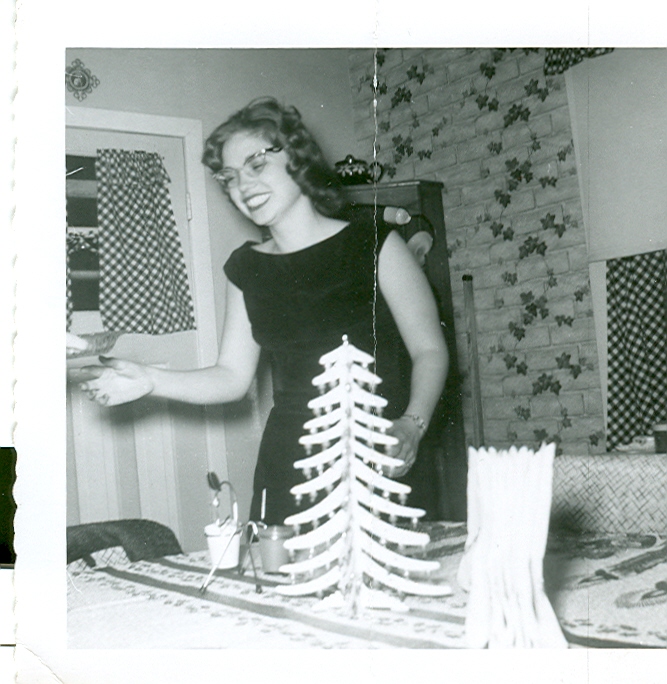
my mom 1My Mom: The first person I laid eyes on, the first person to guide me by the hand, my first love and my first model of leadership. While I didn’t know it as a child and disregarded it as an adolescent, my Mom taught me a lot about leadership.

Like most great leaders, she never sat me down and said: “Now, I will teach you about leadership.” She just led by example: Lesson #1.

When I sat down to draft this post I had a few ideas and thought it would come together easily. Yet, the more I pulled on the threads of memory, the more I had to say, the longer the list became, the more it related to leadership theory and the less I knew how to organize it all. In the end, I think it breaks down into some big themes and some common wisdom that applies to all leaders.

Elaine O’Rourke will never be on the cover of Forbes or Fast Company but here’s my tribute to my Mom’s leadership style. For what is leadership if not the ability to exert a lasting influence on others?

My Mom taught me about:

  1. Servant leadership: I can’t tell you the hours my Mom spent driving my three sisters and me around, typing endless high school papers, not to mention the endless hours of cooking, cleaning, shopping, doctor’s appointments, etc. You really can’t appreciate all that devotion until you are a parent yourself and understand that, just maybe, there were times when she would have preferred to do something else. Through it all, I don’t remember any complaints, it was always done to support our pursuit of the day. We think of it as typical “parent stuff” but it prepares us to be of service to others so that they can meet their objectives.
  2. Motivation: Parents know instinctively what motivates their children. Is it the promise of a reward or the threat of loss?  Is it “eat your dinner and then you can have dessert” or “if you don’t eat your dinner then there will be no dessert”? Different approaches work for different people under different circumstances and my Mom seemed to know how to recalibrate. Regardless of the circumstances, she always offered plenty of praise, mostly sensitive feedback and unbelievable chocolate chip cookies.
  3. Setting positive norms and values: There is lots of research about optimal organizations being those where peoples’ values align with those of their organization. Those values come to life through behaviours and “how we do things.” In our home there was respect for authority, there was kindness, honesty, good manners, taking pride in yourself and there was a solid work ethic. Of course I groaned every time I heard: “If you’re going to do something, do it properly,” but it has served me well.
  4. The importance of celebrating: Oh the feasts! My Mom (and Dad) knew how to throw a party. Every holiday, every birthday, the more the merrier and the effort they put into these celebrations let people know how special they are. They were fostering lasting family and community ties and creating a common history. I learned later in reading Shackleton’s Way: Leadership Lessons from the Great Antarctic Explorer  how important it is for people to eat together, to get to know one another and to celebrate milestones and holidays. It creates goodwill among team members which can be critical during challenging times.
  5. Perseverance: When I was an infant, my Mom discovered that she had advanced kidney disease and was told she should get her affairs in order. She wasn’t going to leave her husband with four young girls at home without a fight so she made arrangements to go to the Mayo Clinic. There, she discovered that she had been misdiagnosed but would need a transplant to survive. It was quite unheard of to challenge a doctor’s authority in those days and the church was not sold on transplantation either. She was undeterred.  After some time on dialysis a donor was found and that gift kept her alive for more than twenty years. This wouldn’t be her last health challenge. During one health scare, Mom received a blood transfusion tainted with Hepatitis C. She fought for years to prove it and to obtain the compensation to which she was entitled. She knew she’d been done wrong by and, ill as she was, she was quite literally not about to take it lying down. She was eventually compensated by the federal and provincial governments but she did not live to see that day.

There is so much more to say but I think I’ll close with more “comMom” wisdom that I use every day.

  • Listen
  • Be optimistic
  • Think critically without criticizing others
  • Do your best
  • Go for it!
  • Say please and thank you (I’m still always behind on Thank you notes but it’s a kind gesture and good networking)
  • Be yourself
  • Don’t take yourself too seriously (“The Devil made me do it” was a favourite phrase of hers.)

I asked a number of friends what their Moms taught them about leadership and the conversation was fascinating. Stay tuned for those insights in a follow-up post. Until then, what did your Mom teach you about leadership?