
The 16 minute MA Leadership… with one edit

I’ve heard that you always make three speeches: the one you prepare, the one you deliver, and the one you give in your head on your way home when it’s all done.

This week, I had the honour of speaking on behalf of my MA Leadership Class of 2012 at the University of Guelph. I prepared a reflection on the program, on my amazing classmates and on leadership in general. The speech was very well received by its intended audience but I do wish I had made one important addition.

Graduation day with my biggest fans and supporters

Towards the 12-minute mark, I made a point to thank the “supporting cast” – the staff of the College of Management and Economics and I mention quite a bit how classmates supported one another;  however, I neglected to mention my family and my classmates’ families. Spouses and extended family who did double duty for two years. Kids who were told “Mom has homework” or “Dad has an assignment due” more times than they care to remember.

Since I have a platform where I can make this edit, I want to thank my indefatigable editor, my husband Mike. He encouraged me when I was completely drowning in my topic and stressed by outlines and deadlines. As immersed as I was, he always provided a fresh perspective and warm encouragement. My children, Robbie and Elise, were also amazing cheerleaders – drawing happy faces in the margins of journal articles; giving a little hug, a word of encouragement or a little trinket; and steering clear when timelines were tight (with Dad’s help, of course). My Dad was a safe place to land; and; friends also, no doubt, heard more than they perhaps wanted to about courses, professors and APA formatting.

No leader achieves success alone and I wanted to thank the entire supporting cast, including those who have been my biggest fans.
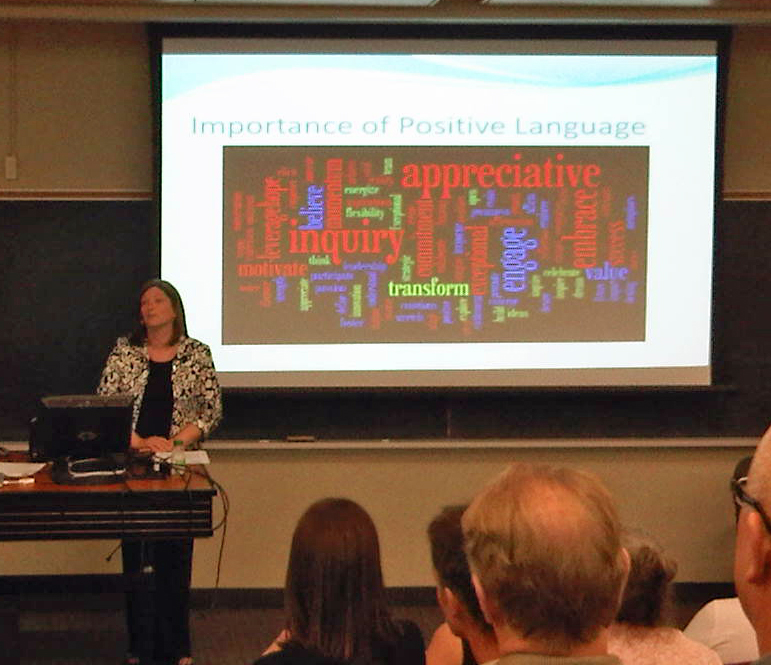
What our collective minds could do together!

Have you ever been in the company of a group of people that you think, collectively, could solve – or at least make some serious headway- on some of the world’s most wicked problems?

From the field of positive psychology, appreciative inquiry focuses on building on what works in an organization.

I had such a priviledge on Wednesday when classmates from my MA Leadership program gathered at the University of Guelph to share the results of their Master’s research projects. While the 10-15 minute presentation window allowed for a variety of research papers, findings and insights to be presented, it did not nearly do justice to the depth of their research.

Since I have asked my friends and classmates to guest post on this blog to provide you with a much fuller picture of their findings, here are a few over-arching themes to whet your appetite.

Leadership Tips & Findings Hot off the Presses

Technology

  • North American leaders need to be far more tech-savvy because a tsunami of new technology is coming. Our leaders are ill-prepared and our cumbersome and expensive governance mechanisms slow our ability to anticipate, innovate and respond to change. Research by @skardiel.
  • Leaders under-communicate vision and do not use available technologies appropriately. In particular, difficult to navigate, busy web-sites are not effectively communicating key policies. Take steps to overcome language barriers and to make critical information easier to access on your web-site.

Emergence

  • Projects rarely unfold in a linear fashion. Elements of data gathering, solutions and implementation take place at all stages of the process. Stay ‘edgy’ and be open to emergent change throughout the process.

Engagement

Employee engagement research shows only 20% of the working population is fully engaged.

  • Appreciative inquiry can build on existing strengths and enhance positive workplace momentum. Do you build on success or focus on disfunction?
  • Coaching interventions work and can build engagement. Are you investing in coaching your people for excellence? Research by TrueBlissCoach also on Twitter @TrueBlissCoach.
  • Invest in career development to engage and retain your key players. Primary research by @lisaw33 showed that career development is positively correlated with affective commitment for fundraisers. In fact, career development opportunities are more important than traditional incentives for retaining and engaging key staff.

Increased commitment = higher engagement = lower turnover.
Don’t skimp on your people!

Trust

  • Build macro-level trust between organizations (or departments) with formal and informal governance mechanisms. Inter-personal trust is insufficient to solve the macro trust problems our society now faces.  (Guess whose presentation this one was? @DTORourke)
  • Similarly, investing in people through coaching and career development (above) are considered  Transaction Specific Investments. They build trust within an organization because they signal a long-term commitment in the individual (goodwill trust) and they build that person’s capacity (competence trust).

Thank you so much to my classmates for their excellent presentations. I still always learn so much from all of you. Looking forward to those guest posts!

Last year at this time I was finishing my second residence stay for the University of Guelph’s MA Leadership. The class was personal skills self-assessment and included a challenging component on feedback (including avoiding the “poop sandwich”). Gwyn, thank you for the reminder. The timing is uncanny and the lesson worth sharing widely.

Gwyn Teatro's avatarYou're Not the Boss of Me

Every once in a while, I like to get back to the basics.  The basics for me are always about people and how we relate to each other.  This post addresses giving and receiving feedback. I know, it is an old topic but I’ll stop talking about it when more of us get better at it. In the meantime, here it is…again.

===========================================================

“Feedback is the breakfast of Champions” or so says Ken Blanchard.But I’m wondering how many of us truly have an appetite for it.   After all, it has a way of feeling like bad news much of the time.

Why is that I wonder?  Well, first of all a very common view of feedback is this.  Feedback equals Criticism.

When I looked up the word criticism, here are some synonyms that greeted me…reprehend, censure, reprobate, condemn, denounce. Okay then, I can’t wait to get me…

View original post 757 more words

A Little Hiatus & Giving Credit Where Credit is Due

A little Hiatus

I am sick with a really bad cold on a really busy week. Since I don’t understand why sick people go to work when they should just focus on getting better, I will resume Twelve Weeks to Trust next week.

I’m also quite certain that no one’s world will crumble if they have to wait a week to find out how informal governance mechanisms (norms & values, shared goals, joint planning & problem solving and bilateral communications) can build trust between organizations. If it does, then thank you for your loyalty but I suspect you may have issues that this blog cannot solve.

Giving Credit Where Credit is Due

Since I did have this in my drafts folder, I thought this might be a good time to explain why I cite the sources of my research with the names and years in brackets which is unusual for a blog.

I cite authors and provide my bibliography because these scholars have published research in peer-reviewed journals – which is extremely difficult to do – and I like to acknowledge the years of research this requires and to give credit where credit is due.

Humbly, I stand on the shoulders of giants – editors of handbooks from Oxford and compendiums! I would never pretend those ideas are my own and I want you to know that the concepts I am presenting are grounded in solid academic research.

I’d like you to trust the information that you find on this blog and by extension, to trust me. So, I am committed to providing highly credible information (no Wikipedia references here) and to provide the references so that you may easily find the same information.

What I have teased out of their research is my doing. How I have mixed it with other research or current events is also my own alchemy. And the broad conclusions, including any errors, are my own.

Should you find any errors or wish to suggest literature that complements or contradicts my current position, then I warmly welcome your input and… I may cite you 🙂

Now, if you’ll excuse me … I’m going to find more tissues and try to “Sharpen the Saw” (Covey, 1989).