How to Build Trust with Formal Governance Mechanisms: Transaction Specific Investments Week 6 Part B – Twelve Weeks to Trust

Transaction Specific Investments… click!… Sounds totally boring. But read on…

Transaction Specific Investments have been repeatedly proven to build trust in inter-organizational relationships.

Sometimes called Relationship Specific Investments (RSIs) or idiosyncratic investments, TSIs are unique investments that support the inter-organizational relationship and its performance.

They may be tangible or intangible but they are not easily transferable to other relationships and they lose their value if the relationship is terminated.

Examples of TSI include a joint marketing effort where the signage and promotional items are specific, a joint production facility or unique hardware, software and training.

From a purely calculative, somewhat negative perspective, TSIs are seen as a “deliberate strategy of locking oneself into a relationship, thus raising switching costs” if one partner choses to defect (Sako & Helper, 1998, p.393). They are referred to as “economic hostages” that control opportunism through economic incentives (Dyer & Singh, 1998).

Imagine you have a joint manufacturing facility – you won’t easily leave the partnership because the costs would be too high. Of course, this doesn’t mean the organizations trust one another – just that they have economic incentives to stay in the partnership. So TSIs alone are insufficient to build trust between organizations. What’s important, again, is how they are used.

TSIs build trust when they:

  • Enhance coordination efforts between buyers and sellers to enable strategic outcomes (Jap, 1999.p.471)
  • Offer a “credible commitment”  They show that the vendor can be believed, cares for the relationship, and is willing to make sacrifices through such investments (Doney & Cannon, 1997; Ganesan, 1994; Geyskens et al., 1998; Sako & Helper, 1998; Zaheer & Venkatraman, 1995; ).
  • Signal a long-term mutual commitment to the relationship which enhances trust, especially if both parties have other exchange alternatives (Ganesan, 1994; Sako & Helper, 1998; Zaheer & Venkatraman, 1995).

A long-term commitment and the expectation that your partner has taken your interests to heart are preconditions for serial equity to occur (Ganesan, 1994; McEvily et al.,2003, p.96). This means that reciprocity doesn’t have to occur immediately because the organization trusts that short term inequities will be corrected in the long-term (Ganesan, 1994; Sako & Helper, 1998; Poppo & Zenger, 2002).

Consistently, research finds that anticipated future longevity of a relationship is positively correlated to trust (Currall & Judge, 1995; Doney & Cannon, 1997; Ganesan, 1994; Sako & Helper,1998).

The length of your past relationship is not nearly as important as where you plan to go together in the future.

Remember how we determined that trust is generative in Week 2? A meta-analysis* by  Geyskens et al. (1998) found that long-term orientation is a consequence of trust and that “the effect of trust on long-term orientation is even substantially larger than the direct effect of economic outcomes or any of the other antecedents” (p.242). So they influence and grow one another.

 For best results: invest in your partners to signal long-term commitment and enhance outcomes. ( I believe this applies to professional development within organizations too!)

As we have seen in Part A and in Part B of Week 6, the use of formal governance mechanisms in IORs can either be seen as an imposition of power used to control the other party or it can be seen as a coordinating mechanism (Bachmann, 2006). When they focus on imposing power and control they erode trust (Kumar, 1996).

When formal governance mechanisms are used as a coordinating mechanism to provide role clarity, help to align interests, signal long-term commitment and provide a framework to support collaborative relationships, they build trust.

Have you seen examples of formal governance structures like hierarchy & monitoring, contracts and TSIs that build trust? Can you think of opportunities to use these formal mechanisms to enhance trust between departments or organizations?

*meta-analysis is a review of a large body of research to draw broader conclusions than you can obtain from a single study.

How to Build Trust with Formal Governance Mechanisms Part A – Hierarchy, Monitoring & Contracts – Week 6 of Twelve Weeks to Trust

There are two undeniable facts in inter-organizational relations:

1. All inter-organizational relationships are linked by a governance framework. Partners agree on structure (alliance, equity partnership, joint venture, etc.) and negotiate how it will be managed with contracts, hierarchy, reporting mechanisms and specific investments.

 “The choice of the form of governance …is the inter-organizational strategy of the firm” (Zaheer & Venkantraman, 1995, p. 375).

If you have a partnership between two organizations, you have a strategy. If you have a strategy, you have a governance mechanism.

2. The role of that governance structure is to “mitigate the risk of opportunistic behavior in the alliance and to foster inter-partner trust” (Rivera-Santos & Rufin, 2010, p. 55).

So, your intent and your approach when you establish this governance structure is critical to building trust.

So much so that Ranjay Gulati of Northwestern University (1995) found that if high trust exists prior to the establishment of a governance structure, less formal governance is required because the perception of opportunism, or the fear of being taken advantage of, is low. This means the costs of governance are lower too.

Trust can influence choice of governance, governance can build trust, and in some cases, trust can be a form of governance – think of a handshake that replaces a contract.

Since inter-organizational governance is part formal structure i.e., hierarchies, contracts, etc. and part informal process i.e., norms, practices, etc. we’ll separate our look at formal governance this week into two parts  and cover informal governance in Week 7 … probably in a few parts as well. (Feedback on post length received!) So let’s look at hierarchy and monitoring today and tackle Contracts and Transaction Specific Investments (TSIs) later this week.

Formal Governance Mechanisms & Trust

First, let’s be very clear that your intent has to be to build trust.If you are focused on imposing power and control, any mechanisms that you put in place will erode trust (Kumar, 1996). Conversely, if they are intended and seen as formal mechanisms to support a collaborative relationship, then they will build trust.

Bart Noteboom put it best:  “Adversarial strategies jeopardize value, and cooperative strategies build value.” (1996, p.985).

Hierarchy & Monitoring

In the economics and business literature in particular, externally enforced safeguards such as hierarchy and monitoring are considered important mechanisms to regulate and monitor activities to reduce the risk of opportunism. They provide access to fiat (authority, sanctions, ability to provide directives), better information disclosure, and incentive and punitive mechanisms to solve problems without the cost of resorting to the courts. In a more positive light, hierarchy and monitoring can also

  • Create role clarity and enhanced information sharing (Kabadayi & Ryu, 2007); and,
  • Boost inter-organizational trust surrounding resource investment where low trust exists but the need for investment is high (Fang et al., 2008, p.94). Basically, tight rules and monitoring create calculative trust (Week 2).

Intent is critical because if the intent is to control and centralize, impose and punish, then parties are acting more out of power and coercion than trust. This leads to conflict and distrust (Ring & Van de Ven, 1994) and less creativity and collaboration (Kumar, 1996). As you can imagine, these have a negative effect on the performance of the alliance (Kabadayi & Ryu, 2007). Ironically, Sako & Helper (1998) also showed that hierarchy does not have a significant effect on attenuating [buyer] opportunism which is its principal objective!

For best results: When mapping out the hierarchy and monitoring mechanisms in your inter-organizational alliance, stress the intent to provide clarity and go lightly on hierarchy, monitoring and control.

Contracts

The intent and approach to contracts and the contracting process can, again, either enhance or erode inter-organizational trust. They build trust when they:

  • Act as a coordinating device for activities (Nooteboom, 1999; Williamson, 1993) and resources (Girmscheid & Brockmann, 2010; Mellewigt et al., 2007)
  • Align interests (Bhattacharya et al., 1998)
  • Provide role clarity and define expectations (Bachmann & Inkpen, 2011; Das & Teng, 2001; Dyer & Chu, 2003; Poppo & Zenger, 2002)
  • Provide ‘institution-based’ or ‘thin trust’ where trust is low by controlling opportunity which can be an important starting point for some relationships. (Woolthuis et al., 2005, p.815)
  • Provide a formal framework for beneficial adjustments to the partnership (Poppo & Zenger, 2002)
  • Provide formal documentation and standardization to informal understandings so that the relationship can be recognized beyond the timespan of the people who initially negotiated it (Ring & Van de Ven, 1994). Like a will.
  • Act as a sign of commitment (Woolthuis et al., 2005). Like a marriage contract.

Bart Nooteboom, Professor of Innovation Policy, observed that sufficient trust has to exist before  a contract is drafted because it “constitutes a relation-specific investment, which one does not want to engage in until sufficient trust has developed to make it likely to be worthwhile” (2006, p.275). Essentially, why invest the time and resources to negotiate a contract with someone you don’t trust?

However, if you have no choice but to work with a partner – freedom, a required element for trust, is missing – then you’re talking about cooperation, maybe coercion, not trust. In this case, Rosalinde Klein Woolthuis’ 2005 longitudinal case study on trust and contract complexity found that “contracts may not work when they are needed most, i.e. in the case of asymmetric dependence” (p.825). They conclude that :

“intentions with which contracts are drawn up and used determine whether contracts and trust are complements or substitutes” (Woolthuis et al., 2005, p. 834).

So again, intent is critical. Notice a theme here?

Contracts that are seen as punitive and controlling, may decrease compliance and impede trust building (Kumar, 1996; Mayer et al., 1995; Morgan & Hunt, 1994). Longer and more complex contracts can create distrust because they “sow the seeds of suspicion” (Mellewigt et al.’s, 2007, p.837) and are actually correlated with greater opportunism (Sako & Helper,1998). Attempts to protect confidential information may also backfire because they “may raise suspicions in the counterpart regarding what else is being withheld” and impede information sharing (Currall & Inkpen, 2006, p.246). And, highly specific contracts can limit partners’ ability to make adjustments that could be beneficial (Gulati & Nickerson, 2008).

More importantly, very detailed contracts can erode goodwill trust and competence trust because they imply that a firm doesn’t fully trust its partner to decide what’s best for the alliance (Das& Teng,2001).

Most compellingly, complex contracts cannot anticipate all forms of cheating that may occur and they increase transaction costs due to the costs of drafting and recontracting.

For best results: Approach contracting as a process to get to know the other organization and its representatives, to outline a common vision, to provide role clarity, to define expectations. At the same time, leave enough space in the contract for innovation and autonomy.

More on Transaction Specific Investments in a few days. Until then, what have your experiences been with hierarchy and monitoring or contracts with a partner organization? What type of case studies have you seen that support or dispute these recommendations?

PS. Full references available in my trust bibliography.

Guest Post – Finding Your Passion

Thursday Guest Post

When you find your passion, you are transformed and anything is possible.

Having worked with Brenda, I can attest to her talent, her contagious passion and her transformative energy which have already touched and transformed so many lives. She is a stellar example of someone who leads by influence and example rather than by authority (although her personal training clients may beg to differ). The following post speaks not only passion but also to self-reverence which is one of the Leader’s Trinity of Excellences. I am thrilled to share my blog “home” with Brenda and hope you visit her blog at LiveFitness~Live to Inspire.

– Dominique

~*~*~*~*~*~*~*~*~*~*~*~

Brenda McKinney, NSCA-CPT, NWS, RHN (in training)

We all want to live happy and fulfilling lives but sometimes we can get stuck in the past or worried about the future and, in the long run, that will prevent us from finding what it is that truly makes us happy—our passion. One of the main problems people have is that most of us have that little voice inside of us that plants those seeds of doubt, I call mine my “faker faker” voice. What if I fail? Reeeeeally, what’s the worst thing that can happen?

In most cases failure can produce some of the best learning opportunities.

But how do you pursue what you’re passionate about if you don’t even know what your passion is?

That probably seems like an odd question but for for 15+ years I thought my passion was my career as an Art Director/Graphics Designer. I even had my own design studio at one point. Then I found my true passion.

In July of 2007 I weighed about 314 lbs. I hadn’t always been heavy,  ironically my “day job” was a large contributing factor on my weight. I worked weird hours. I missed meals. I was always stressed out. I was always eating on the run…and it took a toll on my health.

I decided it was time to let go of “funny fat girl” and hoped that somewhere inside was “skinny funny girl”. By this point I had left my own business – the stress and the crazy hours – to work with an internal marketing team at an insurance company. I was done with the “high profile” that I had worked so hard to achieve. I just wanted to design…because that’s what I loved, right?!

The company I joined had a gym so I hired a personal trainer and began to turn things around. Turns out after a few short months I discovered it wasn’t about “skinny” it was actually about “healthy”.

Then it happened – people started asking questions, sending me random emails, chasing me down in the hallway just to tell me I had inspired them. What?! How could I have the ability to inspire others to make life altering changes?

My real ah-ha moment came while watching the movie “Wall-e”. There were morbidly obese people living on a ship because they had destroyed the planet who were so fat they all had hover chairs and never walked on their own. Then the ship tips and the people all fall off the hover chairs.

THAT is when I realized we were ALL headed for hover chairs if we didn’t smarten up!

So, I went back to school got certified as a Personal Trainer, took nutrition courses and thought: “Well now at least if people ask I can tell “Faker Faker” voice to shut up!”

Turns out my passion is healthy living and I’m working on turning that into a career, and having a “day job” is allowing me to make a living while continuing my education as a Holistic Natural Nutritionist.

I love being able to help people make changes in their lives and I love educating people on how to spread the word to others.

Just pay attention to what your little voice is saying: is it a “want to” or “excited to” versus a “must” or “need to”?

And be sure you’re not not confusing passion with responsibility.Passion isn’t linear, it’s not about getting from point A to point B, it’s about the journey so enjoy the ride.

Whatever you do… Live to Inspire!

For more inspiration from Brenda, visit  her at live-to-inspire.com, follow her on Twitter @Brenda_McKinney or chat on her LiveFitness Page on Facebook.

How did you find your passion? How do you keep that passion alive? How do you tell your “faker faker voice” to shut-up?

Ethics: Goodwill at the Heart of Trust – Week 5 of Twelve Weeks to Trust

Trust without ethics is like a circulatory system without a heart!
Source: yourmedicalguide.blogspot.ca
with permission

Ethics lies at the very heart of trust within your organization and with your stakeholders. So why are its fundamental concepts missing from strategy, marketing and economics literature? It’s like a circulatory system without a heart!

We saw in Week 2 that benevolence/goodwill is a key element to trust. It’s what makes trust a leap of faith rather than a purely calculative exercise.

Goodwill is what motivates a trustor to go beyond their own self-interest for the benefit of their partner. It’s what transforms a transaction into a relationship.

Despite goodwill being “the most precisely defined concept in normative or moral philosophy” (Hosmer, 1995, p. 398) and a vital component of the stronger types of trust (see Week 2), fundamental ethics practices are missing from economics, marketing and management literature.

While many scholars reference Hosmer’s (1995) definition of inter-organizational trust:

“…the expectation by one person, group, or firm of ethically justifiable behavior – that is, morally correct decisions and actions based upon ethical principles of analysis – on the part of the other person, group, or firm in a joint endeavor or economic exchange” ( p.399).

too many disciplines fail to include the obligation- the moral duty– to include the interests of the other party. They also fail to include a description of those ethical principles of analysis.

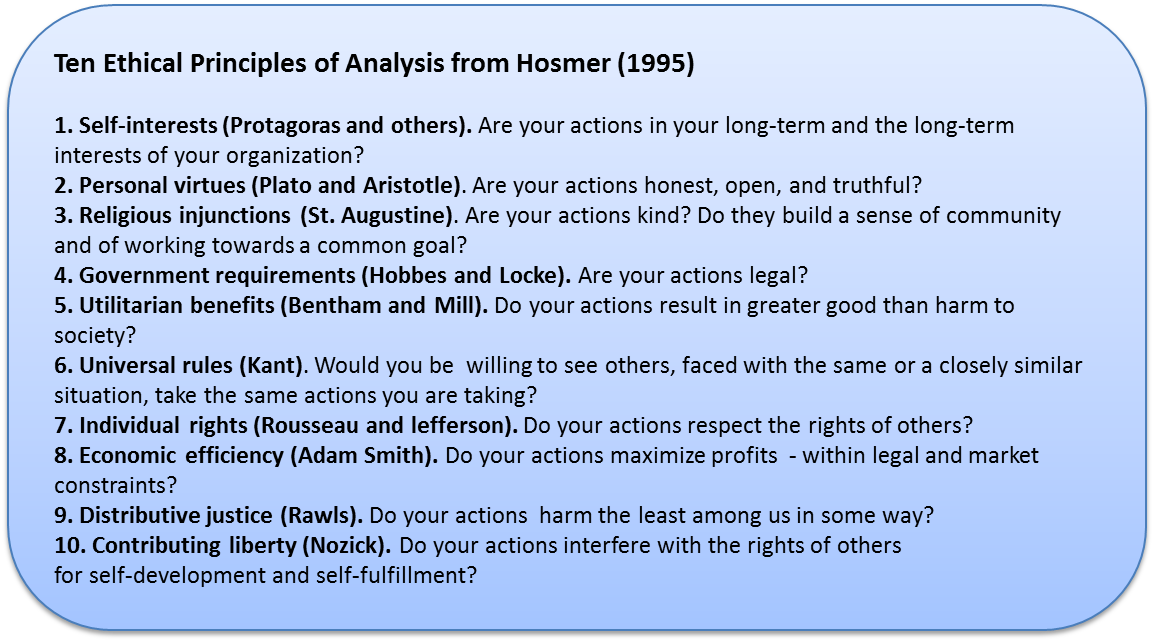
Hosmer (1995) lists ten ethical principles:

Imagine for a moment that you are a trader involved in the mortgage bundling schemes that led to the global financial crisis or a mortgage lender who knowingly lent too much money to families that could not afford it. How would you answer the ethical screens listed above?

It’s no surprise that those corporately sanctioned actions caused severe damage to families, communities and a global economy – they were ethically bankrupt practices that eroded trust.

To restore trust, we need, at a minimum, to critically assess our operations and our relationships.

Think of a practice or policy within your organization, does it pass Hosmer’s ethics check?

While Week 6 and Week 7 will cover how leaders can use formal and informal governance mechanisms to build inter-organizational trust here’s a Golden Rule:

1. Look at your product, processes, partnerships and promotions to ensure they are ethical in every way.

You must also

2.  Behave predictably. “…one cannot have trust without norms. To be trustworthy is to have a behaviour of sticking to agreements” (Pollitt, 2002, p.125).

3. Establish common goals.

4. Demonstrate intentionality. “Look beyond the legal requirements of an agreement and turn to its ultimate intent” (Gullet et al., 2009, p. 336).

5. Apply the principles of trustworthiness and social responsibility in all cases “even when its application might not be optimal in the short run” (Blois, 2003, p.190) – not because it is commercially advantageous but because it is ethical.

I think we misunderstand ethics. We think it’s about playing nicely, staying out of trouble or signing a list of promises every year. It’s an “option” in business schools yet it’s not altruism. It requires self-interest and economic efficiency as much as goodwill.

Ethics can provide scrutiny of business practices that are just as valuable as enterprise risk management.

In my research, I found that it was the ethics literature that examined the downside of trust (Week 10) while others focused on primarily on costs, benefits or governance mechanisms.

The ethics literature prompts leaders to:

  • Closely examine interdependence, power differences or lack of alternatives that can create feelings of entitlement or of obligation which can be exploited in high trust relationships (Greenwood & VanBuren; 2010; Saini, 2010).
  • Identify potential ethical conflicts that can arise when boundary spanners serve both their organization’s interests and the alliance relationship (Gullet et al., 2009, p. 330).
  • Show vigilance when friendships and social ties blur the lines of professional conduct and can contribute to ethically questionable behaviour (Saini, 2010, p.449)

I am by no means an ethics scholar but it is impossible to ignore the lack of focus on ethics and goodwill in much of the broader trust literature; and I strongly believe that therein lies the key differentiating factor for building authentic strong-form trust within and between organizations. The best part is you don’t need additional funding or grand strategies to start asking the right questions in your organization today.