Biomimicry is all the rage so imagine for a moment that you are a Monarch butterfly. It’s been a year of big changes for you.
Wishing you fair skies, butterflies!
Not so long ago you were a caterpillar happily munching on leaves, sunning yourself in a comfy garden patch. Maybe you were a big insect in your tiny patch. Then there was the metamorphosis and now, you’re still trying out your new wings. The occasional gust of wind can turn your world upside down and you’re finding out about the wider world. Maybe you’re feeling pretty small in that big sky.
Out of the blue, you suddenly realize: you have to fly to Mexico. Perhaps you think to yourself :
“Ummmm…. Really? Mexico? Do you know how far that is? Maybe I could make it to Southern Ontario or New York State but Mexico??? That’s unimaginable… That’s impossible! It’s just too big a challenge.”
Despite the enormity of the task something compels you to start on the journey. It feels lonely sometimes. Some days you are buffeted by winds and rainy days delay your progress but you still keep going… somehow. Most of the time you’re not even sure where you’re going…but at least you’re making progress. At some point you find others making a similar journey. They too are persevering , moment by moment, day by day, incrementally moving towards their final destination. And one day you realize “I’m going to make it”. Not only are you going to make it but there will be friends along the journey and friends to greet you when you arrive at your destination. You were made for this!
I thought about this today when I saw little monarchs floating on the breeze. I thought about friends who are on a similar journey
and I wanted to say: I’m wishing you fair skies, little butterflies and there will be a serious margarita party when we get to our version of Mexico.
“According to a survey conducted by the Harvard Kennedy School last year, 68% of Americans believe that there is a “leadership crisis” in the country; and leaders in only four out of thirteen sectors inspire above average confidence (the military, the Supreme Court, non-profits, and medical institutions). Leaders of the news media, Congress, and Wall Street receive the lowest scores.”
Throughout the world we see political leaders embroiled in vile sex scandals and corporate leaders involved in corruption. We are weary of endless, divisive debates. We are just so tired of the resource-sucking, unproductive bickering. Do you feel this way? If so, I suggest you look away from the evening news, business magazine covers or the local daily which are in the business of reporting conflict. Instead, take a refreshing look at sports and community group leaders, church leaders, parent councils, Executive Directors of Not-for-Profits and youth. We have been misled to believe ‘real’ leaders are politicians and CEOs of large, publicly traded companies. While it’s true that these ‘Big L’ leaders wield considerable power, they are greatly outnumbered by the small ‘l’ leaders among us. Another truth is that the ‘us’ and ‘them’ labels are not very helpful.
When I think of leadership, I think of the founders of the Guelph Community Foundation. The initiative was completely volunteer-based and the goal was to build endowments to create a future income stream for community programs and organizations. Ten years later, the Foundation has over $8 million in capital. I think of the Executive Director of Women in Crisis who runs an award-winning, multi-million dollar organization that has immediate and critical impact in the community. She demonstrates vision and leadership everyday but you won’t see her on the cover of a magazine. We are surrounded with examples of vision, hard-work and collaboration. We are surrounded by leaders who, often without formal authority, title, or pay, use some of the most effective leadership techniques to empower those around them and to achieve results.
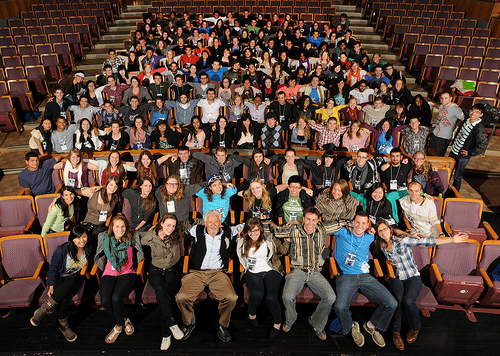
Last week-end I attended an extraordinary gathering of 160 Canadian student sustainability leaders, NGO partners, academics and systems experts from a number of Canadian co-operatives, businesses and municipalities. IMPACT! The Co-operators Youth Program for Sustainability Leadershipprovides Canadian university and college sustainability leaders with the inspiration, skills and networks to be effective catalysts for change. It is an excellent example of corporate leadership providing funding, vision and expertise; academic leadership providing the latest research perspectives; and NGO leadership providing on-the-ground knowledge and opportunities.
Dr. David Suzuki with IMPACT! Leaders
Ten systems experts, ten academic experts, four panelists, three keynote speakers and ten workshop leaders all volunteered their time and shared their expertise at the cornerstone conference. They included local leaders like The Co-operators CEO, Kathy Bardswick; University of Guelph President, Dr. Alastair Summerlee who has started a school in an African refugee camp; Dr. Anne-Marie Zadjlik, founder of Bracelet of Hope Campaignand many others.
In addition to being inspired by Dr. David Suzuki, sector and academic experts, participants heard from their peers. For instance, Jonathan Glencross, 2009 IMPACT! alumnus and the 23-year old behind McGill’s $2.5M Sustainability Projects Fund – the largest university green fund in Canadian history. They worked with Keleigh Annau, IMPACT! alumnae and IMPACT! Fund grant recipient who, at 16, founded Lights Out Canada which provides sustainability curriculum to over 175,000 students nationally. And, while the participants, representing 70 Canadian universities and colleges, are already leading social justice initiatives, environmental awareness projects, architectural readaptation programs, etc. they now have a bit more knowledge, access to seed funding and to each other to help their dreams take flight. IMPACT! is one of many examples of youth leadership in Canada but it illustrates that when we take politics and ambition out of the equation, that when we look more locally at programs and policies that shape our daily lives, leadership is all around us. And it is alive and well.
As Margaret Wheatley suggest, in quantum physics elementary matter can show up as waves or as particles and the movement or location can be measured but never at the same time. If you are trying to measure one, then that is what you will observe. So?
Let’s stop using a microscope to dissect leadership strictly on the Fortune 500, S&P 500 and the TSX and start using a telescope to view the entire system of interactions. I suspect we will find a more encouraging picture of leadership.
Obtaining help is multiplicative. You benefit. The helper benefits. Your team, organization or community benefits.
Fact: people who ask for help accomplish more. And, since power is the ability to get things done, people who ask for help enhance their personal power.
Why is asking so powerful?
People are flattered when they are asked to help. Flattery builds rapport and we are predisposed to help people we like.
People are hardwired to help. Not just Canadians!
When people help, their positive self-perception is enhanced. People want to see themselves as being generous – in terms of time, expertise or resources. When they say “yes” they feel good and look good to others.
Helping builds commitment to your success and your project’s success.
Many hands make light work. You simply accomplish far more by leveraging the contributions of others.
I was reminded of the importance, power and simplicity of asking this week when I approached a local printer for pro-bono materials for my community’s upcoming Random Act of Kindness Day. As is often the case with community projects, there is zero budget and high expectations. This is such a great initiative that it is easy for people to say “yes”. There is little or no cost and the benefits on morale and community building are excellent. Plus, participating organisations benefit from the goodwill that is generated by the event. Still, even with an easy ask, sometimes we hesitate. Why?
According to Jeffrey Pfeffer, author of Power, Why some people have it – and others don’t, we hesitate to ask because it’s uncomfortable, we fear rejection and, we are afraid we won’t seem self-reliant. But studies have shown that these fears are unfounded and that we underestimate others’ willingness to help. More importantly, we have nothing to lose!!!
There is no downside to asking for help. So ask away! Get more done and enhance your personal power in the process.
If you ask for help and the person says “no”, you lose nothing. If they say “yes”, you are ahead. And, if a person declines your initial request, their hard-wired desire to collaborate means they are more likely to concede to a smaller request. While the “large to small” ask is classic negotiation, the “small to large” ask works too. A professional fundraiser I know revealed that when she approaches a major donor, she will often make a small request at first, like speaking to a group or agreeing to an interview for the organisation’s magazine. When the person becomes engaged and begins to see herself as a philanthropist, she becomes more receptive to a request for a major contribution.
Want more? Read every bit of Robert Cialdini’s book Influence (even the footnotes!) and both Jeffrey Pfeffer books Power: Why some people have it and others don’t and Managing with Power: Politics and Influence in Organizations.
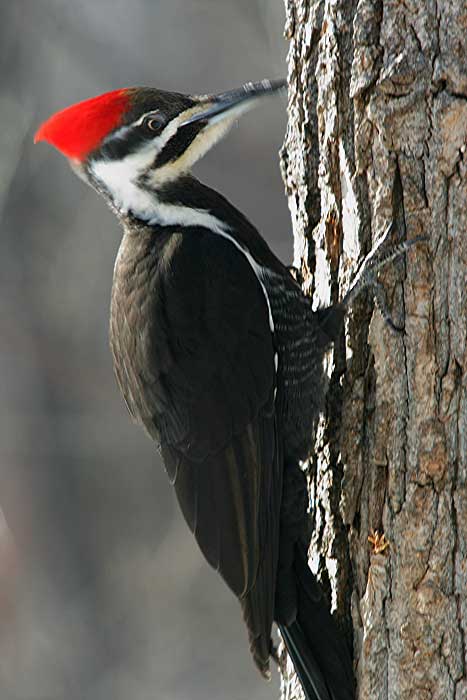
During my cottage holiday I enjoyed a blissful moment of absolute tranquility. I was sitting alone, looking out over the river, really just taking it all in when I noticed two woodpeckers, four or five blue jays dive bombing among the trees, squirrels running about their business, sandpipers along the shore… It was all happening around me as if I wasn’t there. Had I been “doing” something, I would have disturbed their habitat and driven them away. The experience would never have presented itself.
In our workplaces, and even in our families, how often do we barrel through our day, too focused on task or time? Are there things that we have disturbed in our haste and ‘activity’? How often do we set aside time to simply observe? What I propose is different than reflective practice which really focuses on yourself, your experiences and what you are learning from them. I am essentially proposing more unobtrusive, direct observation. By simply watching what takes place around us, without interacting, we can see our environment and the relationships within it in a new way.
Maybe with more observation we can retain some of that cottage relaxation as people barrel through fourth quarter!



 Accolade Communications