Dr. Seuss said it: “Un-slumping yourself is not easily done.” I’ll admit, as a lifelong “achiever”, I’ve been frustrated by my progress in a new environment over the past few months. My boss is happy but I have yet to feel at home or to hit one out of the park. So I gave myself the gift of an objective review of 2012. Turns out, there’s no slump… I’m just a bit impatient!
My review was inspired by a John Maxwell post where he explains that at the end of every year, he goes through every detail in his calendar and evaluates which meetings, projects, initiatives and learning opportunities were worthwhile and which were not. He examines what could be delegated and where he would like to dedicate more time. He looks at highlights of his time with his family and reminisces with his wife. Essentially, he conducts a year in review to gain perspective and to set new objectives.
Here are some of my professional 2012 highlights:
That’s me with President Alastair Summerlee and Peter Senge on the left.
Chaired Random Act of Kindness Day in my community which involved tens of thousands of people in hundreds of workplaces, schools and organizations. That’s hundreds of thousands of kind acts in one day!
Made the shift from six years of consulting to a new job in a new sector with a new team
Just as important, personal highlights included:
Spending great quality time with my family
Chairing School Council and a sub-committee for the Guelph Community Foundation
Taking up Master’s Swimming and running my first Tri-a-tri in ten years!
Why the list? It seems a little self-indulgent, doesn’t it? But why do we wait for others to evaluate us? Why not conduct our own performance review? In his seminal article Managing Oneselfin the Harvard Business Review, Peter Drucker reminds us to assess our strengths, our performance and our values in order to put ourselves in situations where we can excel.
And will you succeed? Yes! You will, indeed! (98 and 3/4 percent guaranteed.) ~ Oh, the Places You’ll Go! by Dr. Seuss
Robocalls directing voters to incorrect polling stations, massive kick-backs to corrupt federal and municipal officials … this doesn’t sound like Canada does it? Sadly, it’s not been a great year for trust in Canadian politics. Our officials and wanna be leaders have done it to themselves and stuck us with serious costs in the process.
Living in Guelph, ON, the epicentre of what’s been called the Robocall scandal, I’ve had a front-row seat to a story that stubbornly refuses to unfold. Here are the basics: during the 2011 federal election, over 7,000 local voters, primarily Liberal-party supporters, received automated calls directing them to incorrect polling stations. When Elections Canada investigated, they found that the calls originated from an Edmonton-based internet provider, displayed the phone number of a prepaid “burner phone” registered to a “Pierre Poutine” of “Separatist Street” and other entirely false credentials.
Elections Canada continues its investigation and I’ll be interested to see how far up the chain of command the trail goes. For a party that wouldn’t let candidates respond to media calls in their own communities, I’m guessing database access and tactics were sanctioned pretty high up the food chain.
What matters even more to me though is the betrayal of voters by people who are running for office in my community! Call me old fashioned but if you want my vote then earn it. Talk to me about policy and vision and can it with your dirty tricks. If I can’t trust you to run a fair campaign, how can I trust you in Parliament?
I’ve written extensively about trust being built on credibility and benevolence. The Robocalls scandal is the absolute antithesis of these. The basic principle of an electoral democracy is that anyone who wants to represent their community and contribute to good public policy at a municipal, provincial or federal level can run for office, often sacrificing more lucrative careers, family time, etc. for love of community or country. There’s the benevolence that seems to have evaporated. The credibility piece comes in with a clear policy platform, substance over style (imagine!), courageous debate and vision. What happened to letting people chose ideas instead of sound bites or personality? Or at least not meddling in the electoral process?
Let’s think about the cost of the distrust created by these Robocalls. I don’t mean the $160 or so that it cost the elusive Pierre Poutine to make them. I mean, what was the cost of Elections Canada staff to field tens of thousands of calls from concerned Canadians? What will be the total cost of the Elections Canada investigation? What are the costs associated with the RCMP’s criminal investigations? How could that money and time have been better spent? How much will new oversight provisions cost in future elections? These are real, hard costs for the taxpayer. They are in addition to the more incalculable metrics like quantifying the cost of Canada’s damaged reputation in monitoring elections abroad or the cost of lower voter engagement. [Excuse me one moment, I need to take a deep breath!]
If you think this trust stuff is all a little naïve and airy fairy, the cold hard costs of distrust should be compelling enough.
These dirty tricks undermined confidence in the electoral process. What about the Charbonneau commission which looked into mafia-related construction kick-backs in Quebec? This raucous, nationally- televised inquiry revealed decades of rampant corruption in Montreal and other cities and prompted the resignation of both the mayors of Montreal and Laval.
A Globe & Mail story points out it’s “a universal story of greed feeding a complex web of construction bosses, politicians and government officials looking for extra profit or political donations.”
Our elected and wannabe elected officials need to understand that Canadian governments started the year with barely a passing grade on trust.
Last February, the Edelman Trust Barometer showed that only 56 per cent of “informed” respondents trust government. That number plummets 10 points to 46 per cent among the “general public”.
In a more recent survey, Parliament, the Prime Minister and political parties fare even worse (great alliteration, depressing stats).
In November, the Americas Barometer (conducted in Canada by Environics) found trust levels for the Canadian Parliament at 17 per cent, political parties at 10 per cent and the Prime Minister at 16 per cent.
You don’t have a lot of room to slip here, fellas! Your licence to operate is in jeopardy and the costs imposed by regulating better conduct will be borne by taxpayers.
Here are a few tips for candidates, political parties and government officials to increase their trust levels in 2013:
Quit the dirty tricks. Don’t hold workshops that promote them and respect the democracy you intend to uphold.
Vigorously root out corruption and sources of distrust. A new police task force in Quebec has been successful in this respect.
Quit the partisan bickering. Get back to your respective assemblies and focus on governing.
There’s no shortage of posts, articles and tweets debating the pros and cons of making a New Year’s resolution. It’s a silly debate because it’s not about the resolution, it’s about the outcome. People aren’t averse to setting goals, they’re afraid of failing. So instead of making a promise, make a plan.
In her column, Take a Flying Leap, in the January O Magazine, Martha Beck points out: “The leap from your mind to your calendar is the moment of commitment.” So if you want to see friends more often, pick up the phone now and book three dinner parties… voilà, resolution kept.
While my archive post below speaks to small steps, Beck’s got me thinking about loftier goals. Had the Mayans been right, I’m not sure I would have loved my last day on earth. It’s time for me to set the next big goal. (That’s going to make my husband really nervous!) As Beck writes, “You’ll live through every leap except the big one at the end. And even if you never leap, you’ll die anyway.” Guess there’s no time like the present. Here we goooooooooooo!
From the archives, but still holds true.
Embrace… then delegate the New Year’s Re:Solution
Why do we roll our eyes when we contemplate New Year’s resolutions? They are a moment when we’re honest with ourselves about a particular aspect of our lives that could use some improvement – be it fitness or an underwear drawer that could use an overhaul. Resolutions are an acknowledgment of a need to improve and grow and are often the root of establishing a personal vision. Honesty, personal growth and vision are all positive attributes so… why the long faces? A friend who is studying guided meditation suggests that the term ‘resolution’ puts a lot of pressure on us and we are disappointed when we ‘fail’.
If we reframe the concept from an imposition to an intention, then we relieve some of that pressure and turn a negative connotation into a positive one.
Another way to reframe is to focus on the “solution” part of the word. The re:solution is an opportunity to fix something that’s off and, since we can’t always find solutions ourselves, why not delegate part of the solution to maximize your chances of accomplishing your objectives? When you have a sore tooth, you call a dentist. So if your issue is fitness, call a trainer. Want to tackle pesky perfectionism? Book an appointment with a counselor. If you keep meaning to freshen up your home, call a painter. If learning a new language is languishing on your bucket list, sign up for a class. It doesn’t have to cost any money. If you want to clean out the garage, pick a date and ask a friend to help you out. You’ll have fun, spend time with someone you love and accomplish your objective. The act of delegating all or part of your resolution commits you to act on it. Do it now and you can be one of “those people” who love New Year’s Resolutions.
Tips for Successful Re:Solutions
1.Congratulate yourself for your vision and commitment to personal growth
2.Acknowledge that you are worth it
3.Frame your resolution as a positive action. For example, if you have a health and fitness goal: walk daily; try a new vegetable every month; book time with a trainer; etc… (Studies show it’s more difficult to stop doing something than do add something new)
4.Enlist professional help: trainer, nutritionist, painter, counselor, teacher,…
5.Keep it clear and simple and get it done early.
This holiday season if you ask better questions than “How’s work?”, “How are the kids?” or “Would you please pass the yams?” you will be rewarded with vastly more interesting conversations.
Originally published in April 2012, this blog post has been one of my most popular. I reuse ornaments so I thought I’d dust off this post as well since the art of great conversation is always timely, especially when friends and family gather. I hope it helps you to learn new things about the people you thought you knew best.
Last night at the dinner table my kids starting talking about wanting to rule the world so I asked “OK, if you DID rule the world, what is the one thing you would change?” My six-year old responded, “I would let dogs into all buildings.” My almost nine-year old said, “I would have free videogames for a month every year.” My husband said he would ban all guns and I couldn’t decide between eliminating borders (because that’s what people fight over) or income disparity. No matter what the response is, it’s a great exercise in listening, in understanding another’s perspective and in appreciating different points of view.
From my dinner table to yours, I wish you rich conversations over the holidays and health and prosperity in the New Year.
********************
Originally posted: Put down the smart phone and ask a great question
April 1, 2012
At a business lunch, I noticed that almost everyone left their phones on the table in front of them. Are they waiting for someone more interesting to call? In a pub on St. Patrick’s Day, at least half the people were holding phones, telling others… what? That they are having such a great time? If that’s true, why don’t they put the phone down and say that to the people in front of them? I have no objection to texting a friend so they can meet up with you but when you are intent on documenting all your moments for people who are not there, aren’t you missing out on the experience of actually being present, with the people who are there? Or if you are constantly checking your phone to read other people’s Facebook posts, texts, Tweets or e-mails, are you telling the people you are sitting with that you’d rather be elsewhere? Then last week I saw a woman take her iPhone to communion. Seriously…. someone more important than God is going to call, text, Tweet, Facebook or BBM you in the 30 seconds it takes you to walk up there?
Shake it off people! I know it’s our reptilian brain that is easily distracted. It’s the ego that’s fed whenever others respond to your picture, post or Pinterest…. but we are not Pavlove’s Dog. We do not have to react to every flashing light, every beep, every tweet and text.
As my high school French teacher used to say when the bell rang: “Dogs respond to bells. People respond to other people.” So the next time you’re sitting at a lunch, hanging out in a pub or having a meal with friends or family, embrace the opportunity to get to know something new about the people around you, to deepen your relationships and to challenge your assumptions. You can’t do that in a tweet or Facebook post.
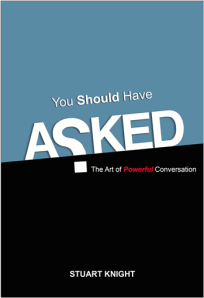
In his book, You Should Have Asked, Stewart Knight recounts how asking “Which Canadian do you most admire?” at a family reunion led to a rich conversation about his father’s immigrant roots and political hero and his mother’s literary tastes – two aspects of his parent’s lives he had completely ignored until that day. His book offers an easy approach to creating powerful conversations by asking good questions. Knight writes:
“With powerful conversations, instead of learning where a person lives, you will discover one of their favourite childhood memories. With powerful conversations, instead of knowing what a person does for a living, you will find out what that person does as a passion. You will discover the intricate and fascinating details of what makes that person who they are” (p.38).
Not only will you benefit from a more interesting discussion and a deeper relationship but, according Robert Cialdini author of Influence: Science and Practice, when you identify something you have in common with another person, that similarity leads to liking, reciprocity, stronger networks and a greater ability to accomplish your personal or professional objectives. Within an organization, research from Ken Blanchard found that connectedness to the leader – the extent to which leaders make an effort to build rapport and personal and professional relationships – leads to greater discretionary effort and higher intent to remain with your organization. Connectedness to colleagues – the extent to which colleagues make an effort to build rapport and personal and professional relationships – is also positively correlated with discretionary effort and organizational citizenship behaviours. So people who feel connected to their co-workers are more apt to go the extra mile at work. Bottom line: there are compelling personal and professional reasons to be fascinated by others, to honour their uniqueness and to ditch the small talk:
Ask open ended questions like:
• What do you like most about what you do?
• What led you to this type of work/hobby/pursuit?
• What would you change about your industry/community/legislation/etc?
• What did you want to be when you were a child?
To borrow a few from Knight (and he has a ton of great ones):
• Out of all the jobs in the country, which one do you think would have the most devastating impact on society if those people didn’t show up for work? And what would be the worst day of the year for them to not show up? Why?
• Ask people why they live, work or travel where they do.
Listen and build your next question on what you have just heard.
Stop worrying that asking questions makes you look like you don’t know anything – you certainly don’t know everything so get over it.
Ask how things work, why they are that way, what makes a process so difficult.
Embrace the opportunity to learn!
Great questions are the ultimate mobile app so use them wherever you go! After reading Knight’s book, my husband started asking our kids a ‘Question of the Night’ at the dinner table and the conversations are fantastic. It gives the kids a chance to practice listening skills and also to respond to a serious question where there’s no right answer. Our favourites include:
If you could go anywhere on a family vacation where would we go and why?
If you had a superpower, what would it be?
When you are a parent, which rules will you enforce in your home?
If you could only eat one food for the rest of your life, what would it be?
To boost our dinner table topic creativity I recently purchased The Box Girls Family Diner Box of Questions. Try these at home, with friends or at the office or leave the cards out on tables during a party and watch the level of conversation rise! Another great resource (that also comes with a mobile App) is the Story Starter Pack. My favourite question here is : “If you could dig a tunnel from your house to anywhere in the neighbourhood/country/world, where would it go?”
You deserve the gift of more fun, meaningful and memorable conversations and the deeper relationships that result from them. Your co-workers, friends and family deserve to feel worthy of your attention. Try it! You can tell everyone about it on social media…. later. And, please tell me…. what’s your favourite “deep question” ? And what happened the last time you asked one?







 Accolade Communications