
The power of conversation: Vital Youth

Community Foundations of Canada Vital Youth Report GenerationFluxAccolade Communications had the honour of working with Community Foundations of Canada on their 2012 Vital Signs Report titled #GenerationFlux: Understanding the Seismic Shifts that are Shaking Canada’s Youth. I not only had the opportunity to learn about a very timely subject, I also re-learned some broader lessons.

Challenge old assumptions

Beyond the content of the report which shows a difficult confluence of factors facing today’s youth (high debt, double national unemployment levels, high cost of living, etc.), I learned that my 20-year old assumptions no longer held. While I still consider myself “young” at 39, I have been judging younger people based on what my tuition cost at the time, the fact that I was employed etc.

The fact is, statistically, my old assumptions are incorrect.  When discussing the report’s findings with others, I find that they are often quick to dismiss anything they find objectionable and really struggle to challenge their own assumptions. We point to one anecdote rather than open our minds to what the statistical trends are showing. Why are we so afraid to be “wrong”? Revising your position after 20 years doesn’t make you wrong!

C’mon, try it! For  a minute, open your mind and say “What if all this is really true? How does that change the picture?”

Try a little empathy and collaboration

Perhaps we’re influenced by the current “us vs. them” in media and politics but let’s try a little empathy. The report found that while youth unemployment is high, baby boomers (the 55+ demographic) are staying in the labour market longer. This may be because their savings took a beating in the last decade or perhaps they don’t have enough for retirement. Some people just want to keep working because they enjoy it.

The point is not to blame anyone for the existing scenario, they are just neutral facts – we don’t need to inject judgement and divisiveness.

“Kids today have it so easy” or “The boomers aren’t leaving” aren’t helpful statements. They are stuck in caricatures of one another, rooted in the past and bring nothing new to the discussion.

I hear many people talking about “these kids who have finished university and they’re moving back in with their parents”. There is judgement in that statement, like somehow they have failed to “make it”. Do you think a young person who imagines she’s the next Mark Zukerberg wants to move in with her folks? It’s not exactly romance central if you know what I mean (don’t read this Dad). Yet Rob Carrick’s column in the Globe and Mail just the other day pointed out that there are affordability and accessibility issues in many Canadian markets and, in some cases, the best financial decision a young person can make is often to “boomerang”  back home and save for a down payment.

It costs you nothing to imagine yourself in the others’ shoes for a moment. Imagine you’re one of those boomers staying in the labour market because you have kids in university and parents who need nursing care. Imagine you’re the student with high debt but also high ambition and skills who is hitting a brick wall.

Facts are facts. The question is “where do we go from here to have the type of country we want?”

Join the conversation

I am thrilled with the coverage and the dialogue that has already been sparked by Vital Youth. Yesterday I attended a Vital Youth dialogue with 35 young people and representatives of youth-serving organizations. We came up with concrete community initiatives that could begin to address some key issues raised in the report, including re-imagining what ‘success’ looks like, skill-sharing arrangements and reconfiguring programs and organizations to really include youth in decision-making (and looking at whether your location is on a bus-route, whether your meeting times conflict with class schedules, etc.). The conversation is taking place on news sites and social media and will take place in communities across Canada throughout the year. They can take place in your workplace, your home, your City Council. Of course, issues like funding for youth mental health require broader public policy commitments but we all have a role to play in moving from statistics to solutions.

On this, or any other issue, a respectful and constructive dialogue focused on solutions is the only way forward. Let’s embrace it!

Why encourage those in the middle of the pack and those who are dead last?

Remember the Seinfeld episode where George worries about worlds colliding? Well, fair warning: here’s a post where leadership, parenting, ranting and sound advice collide.

encouragment and perseveranceLast Friday, my 8-year old son participated in a city-wide cross-country track race. I went to encourage him and to help out his teachers; but what started like a little parenting side-trip turned into a profound leadership observation with implications for businesses and communities.

I noticed that all the parents and classmates gather at the start line of the 1km race for pictures and encouragement and then they race to the finish line to applaud their child’s achievement. Of course, that’s natural and it’s great parenting.

However, after the first group of front-runners crosses the finish line, the applause and encouragement is not as loud. People drift away with their kids as the middle group and the ‘stragglers’ finish up. So, after my son’s race, I deliberately found a stretch in the middle of the course where there was no one shouting encouragement. I stayed past those nipping at the heels of the pace bunny and I waited for the group in the middle and, especially, for the kids who were at the end of their group.

I shouted really simple things like “You’re half-way there”, “You look awesome”, “Nice stride” and “You can do it.” What I saw amazed me. Just the presence of someone there made them perk up, start running again, lengthen their gait. I saw kids literally lift off the ground (once their face stopped saying “Who is this lady and why is she shouting at me?”).

I started thinking about how everyone cheers for the winners; but what about the kids who had the courage to sign up for something outside their comfort zone? Who’s cheering for them and the courage and perseverance they’ve displayed? There’s a huge crowd around the “winner”. The “winners” will be encouraged to keep going. The “winners” will be invited to special training to improve even more.

Where’s the crowd around the courageous? the brave? the tenacious? The chubby kid who’s trying? The kid with Downs Syndrome or with less visible challenges?

I just did a mini-triathlon in September and, hardly a natural athlete, I know what it’s like to be at the very back of the group. I know what it’s like to have to walk many parts of a race. I also know what it took for me to sign up, to train, to show up. Of course,  they tell the kids “run your own race” but that’s hard to do when you see a big group of kids pulling away in the distance. It’s still discouraging. I know what it’s like to pull out of a race in junior high because you’re just so far behind you don’t think you’ll finish and you’re embarrassed.

I admit, I got a little pissed off that parents were leaving as soon as their kids’ race was over. Why was I alone cheering on these kids in the lonely stretch? Yes, their teachers were at the finish line. Yes, I had the luxury of time on my side that day but aren’t they all our kids? Don’t they all deserve to have someone there to cheer them on – whether they are first or last? Especially if they are last? Otherwise, they  just won’t come next time.

In our community, where else can we encourage the kids who are struggling?

In our workplace, are we cheering on the superstars and drifting away when the “average” workers – the solid, consistent people – come through because a “win” is exciting but a finish is expected?

Are we encouraging those who are struggling, especially when there are specific challenges they are trying to overcome? An ‘average’ worker who is keeping it together despite being torn-apart because a parent is dying (I have been there too). An ‘average’ worker who is still delivering despite a marriage falling apart. Do we recognize the extraordinary efforts it sometimes takes to be “average”?

I’m just suggesting that we try to be there for everyone who’s in the race – literal or figurative – because when we encourage others – in that lonely stretch where people are struggling – people will literally rise off the ground, lengthen their gait and hear the crowd cheering for them. They will return to try again. They will start to see themselves differently. They may never be first but maybe they’ll be faster, stronger, happier and more confident.

Book Review: Smart Trust

If you read only one book on trust-building, this should be it. It’s timely, practical and compelling .- me

trust book    I don’t say that lightly, I’ve read a ton of articles about trust. You’ve also read my review of Onwards so you know I don’t sugar coat it. I also don’t receive any compensation for my opinions. I’m coming from a place of integrity and authenticity.

Smart Trust by Stephen M. R. Covey and Greg Link  was published in January of this year so the  trust statistics are all very recent as are the varied and plentiful examples.  For organizations ranging from PepsiCo, Zappos, Berkshire Hathaway and Costco to the Honesty Coffee Shop     in Batan, coaches and political leaders in Columbia, Smart Trust principles can apply to any size organization in any industry.

Perhaps I liked the book so much because I am a fervent believer that “trust is a performance multiplier” for societies, organizations and people and I am concerned by the costs that lack of trust entail and believe in its many benefits.

As the authors put it “Low trust creates a tax-a wasted tax – that penalizes interactions and diminishes prosperity.” (p.17) “There’s a cost to excessive rules and regulations in terms of both administration and also creative energy.” (p.46)

Within organizations these taxes include redundancy, bureaucracy, politics, disengagement, turnover, churn and fraud. We don’t want to work in places like this or live in societies like these.

Smart Trust also concords with my view that trust can build quickly and that it builds upon itself. This is quite different than what psychology scholars have been telling us for some time. In their view, trust had to begin at an interpersonal level and evolve slowly as people judge each interaction. Here, we’re talking about a multiplier effect that is much faster.

The Covey-Link approach is also very empowering and gives responsibility to individuals from the CEO to the shop floor to:

  1. Choose to believe in trust
  2. Start with yourself
  3. Declare your intent and assume positive intent
  4. Do what you say
  5. Lead out in extending trust

The book is also a lot of fun to read. From the Dilbert cartoons that sometimes hit a little close to home to really vivid stories. My favourite story involves the CEO of Continental Airlines who “took stacks of company policy manuals that were filled with minutia-controlling regulations out to the parking lot and had employees set fire to them. He told them that from now on, instead of following some rigid manual, they were to use their own judgment in solving problems.” (p.199)

Psychologists call that changing a cognitive post. Holy Hannah, I guess so! In a dramatic gesture, Gordon Bethune showed his employees that he trusted them to use their judgement and to do their work. Under his leadership (and no doubt, the employees’ followership) Continental went from being ranked worst in every performance category to winning more J.D. Power awards for customer satisfaction than any other airline in the world.

“A boss’ job- a leader’s job – is to facilitate, not to control. You have to trust people to do their jobs. That’s the strongest leadership there is. Trusting your employees.” – Gordon Bethune, Former CEO, Continental Airlines

Ultimately, this is a business book. It sets out a solid case for the benefits of trust and the costs of distrust. It identifies and addresses how to avoid blind trust and a number of ‘fake trust’ approaches which are not helpful. It also encourages swift action in the event of a breach of trust. While it gives tons of practical ideas on how leaders can build trust, it also empowers individuals at any place in society or an organization to “lift where you stand” because collectively the trust-building efforts are all important.

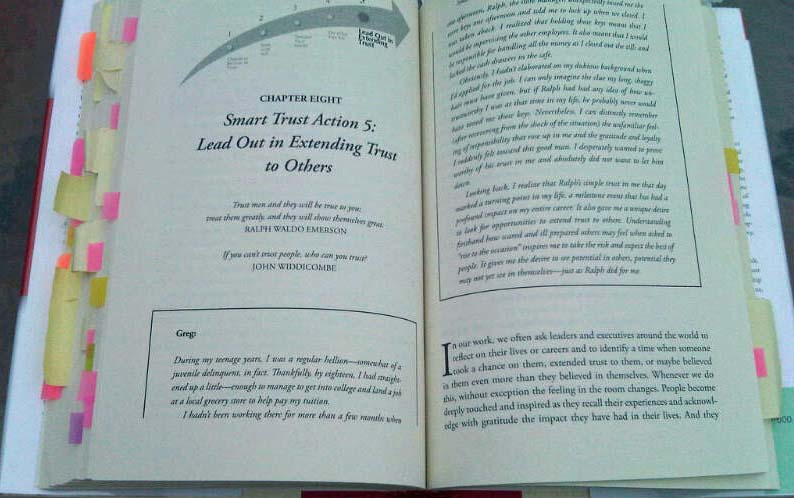
Have you read Smart Trust? If so, what did you find most compelling? Did your copy end up looking like this? Definitely, my copy is going to get much worse as it will be re-read and referenced extensively.

smart trust business book   

From the Archives: My Anchor belief: Trust-building STARTS with culture & structure

John Morgan, the author of Brand Against the Machine, says any vibrant organization must have an anchor belief. Here’s mine:

Please!!  Stop thinking trust has something to do with being liked, or saying ‘we’. Stop thinking trust has to start at the interpersonal level. Stop thinking trust has to evolve slowly or is strictly based on past relationships.

Understand the complexity of trust. Understand that you can build and support trust with policies, practices and mechanisms in your organization.

The most trustworthy individual can’t build or sustain trust within the organization or with partners if the organization doesn’t have the right culture and structure in place.

My anchor belief: Trust can be swift. Trust can be built through governance. Trust can start at the inter-organizational level and move to the inter-personal.

DANGER: This turns a lot of trust research on its head. Usually, scholars start at the interpersonal level and build incrementally from there (check out Types of Trust in Twelve Weeks to Trust). Some scholars don’t believe you can trust an organization, only the people within it. But…

Macro level-problems need macro-level, institutional solutions because organizations are bigger than any one person or leader.

Leaders can start structurally to show people on your team that they-and the organization- are trustworthy.You can start today!

  1. Always declare your benevolent intent. Suspicion breeds distrust so open up the lines of communication.
  2. Reduce hierarchy and monitoring. Set up clear performance expectations through performance agreements, which are a type of contract, and then get out of the way!
  3. Invest in peoples’ financial or psychological security through transaction specific investments like training or equipment they need to do their job.
  4. Establish positive team norms that value trustworthiness. Lead by example and support the norms by policies, incentives, etc.
  5. Talk about ethics. Live them. Run your product, policies and practices through these 10 ethics screening questions. Punish ethics violators.
  6. Create mechanisms for joint planning and problem solving – joint planning meetings, requests for input at various points in a project, stand-up brainstorm meetings or a quick phone call. Create joint goals and incentives so that everyone has something to gain from the others’ success.
  7. Put your money where your mouth is. Nothing is more tangible within an organization than budget. Ensure you have the right people on your team and that you resource projects appropriately otherwise you’ve set them up to fail which does not exactly foster warm fuzzy feelings or trust.

A lot of the focus of inter-personal trust is to show benevolence – that you care about the other person and can put their needs first. You demonstrate that when you create a work environment that has a culture and a structure that supports trust.

When trust-building practices are institutionalized, trust is sustained beyond the actions of one manager or leader. Trust becomes “how we do business” or in fancier terms, an operating mechanism.

An amazing thing about trust is that it is generative. Once you start to create it, it builds upon itself to create more trust. So, today, start where you can. Begin to infuse trust in the big machinery that is an organization and you will be amazed by the transformation that can take place.

Worried about budgets? Most of these steps don’t cost anything and as you build trust you reduce the need for double-checking, tight contracts, etc. High trust governance is less expensive than control and monitoring. You will free up funds to invest in people, projects, training, etc.