
Eleven Leadership Lessons from the Co-operative Model

Source: The Co-operators

Forget the caricature that all co-ops are crunchy granola communes. The co-operative business model is found in all sectors from large financial institutions and global retailers to funeral co-ops, communications firms, health clinics, day cares and book stores. Collectively, Canadian co-operatives and credit unions boast 18 million memberships and an asset size of $330 billion – yes, that’s a ‘B’ for billion! (source: The Co-operators & www.canada2012.coop ) And, major Canadian co-ops in financial services and retail top the list of Canada’s Best Corporate Citizens and are prominent in the list of Canada’s best employers.

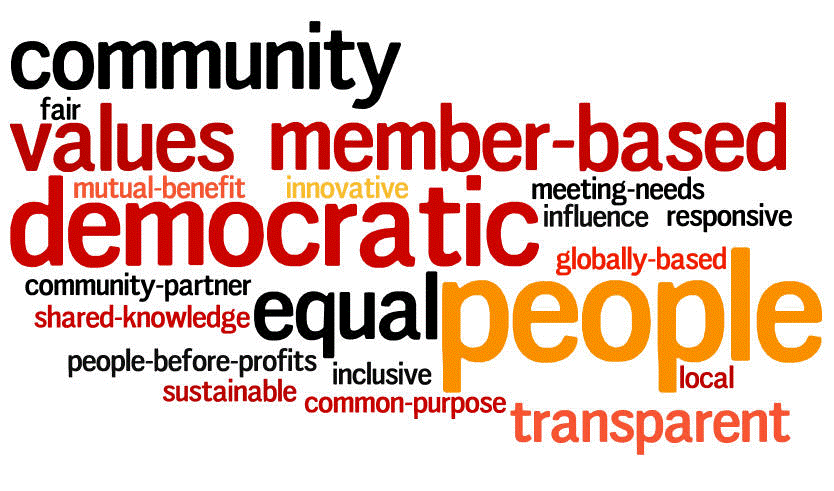
The secret to the success of co-operatives? Co-ops are values-based organizations guided by seven principles that ensure democracy, equality and commitment to their members and to local, national and global communities. Inherent in these are core leadership principles that contribute to the success of co-operative enterprises around the world.

  1. Values-based and centered. Member, community and organizational values guide the enterprise. Research shows that when employees’ values align with organizational values, the result is greater productivity and engagement.
  2. Joint planning & decision-making. By creating a common vision and contributing to decisions, members are committed to the success of the enterprise.
  3. Equality. Unlike stock companies where a huge shareholder can hold all the power, each co-op member has an equal voice. This upholds important principles of distributive and procedural justice.
  4. Listening. The principle of “One member, one vote” ensures the perspectives and needs of all members are considered. This can flag potential pitfalls or create value for products and services.
  5. Economic Participation. Ten dollars at the credit union, $5 at MEC, or substantially larger amounts… the cost of membership varies; but what’s more important is that co-op members contribute, at least nominally, to the capital of their co-operative. According to Robert Cialdini, author of the book Influence, even a small contribution engenders commitment.
  6. Reinvested profits. Surpluses are re-invested in the co-operative for development, reserves, member benefits or other activities approved by the membership.
  7. Education and training. Ongoing training of members, elected representatives, managers and employees fosters engagement and contributes to ongoing improvement within the organization. This investment is not optional, it is a core co-operative principle.
  8. Communication. Informing the general public about the nature and benefits of co-operation highlights the unique point of difference of the business and flags commonly held values.
  9. Co-operation within the Network.  Co-operatives work together through local, national and international structures to leverage the network’s broad range of strengths and perspectives.
  10. Concern for Community. Before CSR was fashionable, co-ops emerged as locally-grown business solutions to pressing community problems. Striving for social justice, ecologically sound and economically viable business – that’s not fashion, that’s co-operation.
  11. Rooted in Community. Community-based co-ops not only provide local employment, they are often the only credit union or food store in the community. Where large multi-nationals see small markets with low profit margins, co-ops see an opportunity to serve community needs.

The United Nations has unanimously declared 2012 the International Year of Co-operatives. Find out more about how “Co-operative Enterprises Build a Better World”.


http://www.canada2012.coop/

http://www.2012.coop/

http://www.un.org/en/events/coopsyear/

For International Women’s Day! 5 minutes for 3 women who changed the world

modified from January 12, 2012

It’s the first time that three women share the Nobel Peace Prize and their stories are of amazing leadership that brought an end to decades-long dictatorships.

So why are they nowhere to be found on Barbara Walter’s list of the 10 Most Fascinating People of 2011? Arguably, their contribution is more remarkable than say… the Kardashians? Are their stories not more interesting than Pippa Middleton’s love life or Donald Trump’s hair?  I admit, I first heard about Leymah Gbowee on The Daily Show with Jon Stewart but it led me to question why media empires serve us a steady diet of drivel and why we eat it up. That’s why I invite you to balance and enrich your leisure time diet by finding out more about 2011 Nobel Peace Prize laureates:  President Ellen Johnson Sirleaf and Leymah Gbowee, both of Liberia, and Yemeni activist, Tawakkol Karman, the first Arab woman to receive the prize.

Yes, there are only 24 hours in the day, and it’s ok to indulge in some American sports and entertainment brain candy. But today, right now, embrace the opportunity to provide some balance in your ‘entertainment’ diet and discover more about our world and its inspiring leaders. These women are the Martin Luther King Jr. and Nelson Mandelas of our time! I promise, you will be moved beyond anything that Hollywood can conjure up.

If you have

I have never asked that you share one of my posts with others but please share this one. Certainly not for me but in honour of these women who, by all rights, should be household names not only in their own countries but throughout the world.

Namaste!

Embrace…then delegate… the New Year’s Re:solution

Why do we roll our eyes when we contemplate New Year’s resolutions? They are a moment when we’re honest with ourselves about a particular aspect of our lives that could use some improvement – be it fitness or an underwear drawer that could use an overhaul. Resolutions are an acknowledgment of a need to improve and grow and are often the root of establishing a personal vision. Honesty, personal growth and vision are all positive attributes so… why the long faces? A friend who is studying guided meditation suggests that the term ‘resolution’ puts a lot of pressure on us and we are disappointed when we ‘fail’.

 If we reframe the concept from an imposition to an intention, then we relieve some of that pressure and turn a negative connotation into a positive one.

Another way to reframe is to focus on the “solution” part of the word. The re:solution  is an opportunity to fix something that’s off and, since we can’t always find solutions ourselves, why not delegate part of the solution to maximize your chances of accomplishing your objectives? When you have a sore tooth, you call a dentist. So if your issue is fitness, call a trainer. Want to tackle pesky perfectionism? Book an appointment with a counselor. If you keep meaning to freshen up your home, call a painter. If learning a new language is languishing on your bucket list, sign up for a class. It doesn’t have to cost any money. If you want to clean out the garage, pick a date and ask a friend to help you out. You’ll have fun, spend time with someone you love and accomplish your objective. The act of delegating all or part of your resolution commits you to act on it. Do it now and you can be one of “those people” who love New Year’s Resolutions.

Tips for Successful Re:Solutions

  1. Congratulate yourself for your vision and commitment to personal growth
  2. Acknowledge that you are worth it
  3. Frame your resolution as a positive action. For example, if you have a health and fitness goal: walk daily; try a new vegetable every month; book time with a trainer; etc… (Studies show it’s more difficult to stop doing something than do add something new)
  4. Enlist professional help: trainer, nutritionist, painter, counselor, teacher,…
  5. Keep it clear and simple and get it done early.

Just do it! You’re worth it! Happy New Year!

How is framing your message for media or government like E-Harmony?

Media and government relations and dating sites like E-Harmony both involve:

  • identifying key people with shared interests
  • deeply understanding the other’s background and needs
  • positioning yourself for joint success
  • building relationships

Build your Contact Plan

In both media and government relations, mapping out a comprehensive contact plan is an important place to begin. For media, include local media outlets, specialized reporters and bloggers. Think about industry publications and editorial opportunities like guest columns or Op Eds. In government relations you want to be political but non-partisan so be sure to include all parties, elected and non-elected decision-makers, key staffers and members of key committees. To ensure you include all important ministries and think broadly about your issue and its implications. Who ‘wins’ if your proposal is adopted? For example, an environmental issue may have economic development, natural resources, agriculture or municipal affairs angles. You’ll want to build a broad coalition of support for your issue.

Understand where they’re coming from

Everyone on your contact plan is juggling competing priorities, facing tight deadlines and trying to accomplish their own objectives. The more you understand where they’re coming from and what they are trying to accomplish, the better you can tailor your approach to suit their needs and advance your position. For example, reporters are working on tight deadlines and looking for compelling, new, and local or human interest stories – preferably with strong visuals. Elected officials are trying to fulfill election promises, answer to a constituency, meet the expectations of diverse groups and perhaps advance their own position within their party. Check out election promises, Throne Speeches, any documents that help you understand how advancing your issue helps them accomplish their objectives.

Position Yourself for Joint Success

Make is easy for reporters by providing information that is relevant, local, human, timely, newsworthy and suitable for their format. “Always be clippable” and able to provide a compelling story or statistic. Boil your story down to two or three key messages that can be supplemented with additional supporting details. When your audience is policymakers, make it a win for them to advance your issue by demonstrating that it is a compelling issue for their constituents. Provide strong and credible background research. Pull together a broad coalition of support for your positions and have a very clear “ask” and understanding of how it can happen. If possible, provide proposed draft wording for the legislative change or regulation.

Develop Relationships

Media and government relations are a process. Just as in our personal relationships, it’s important to behave with integrity, to return calls, to find opportunities to reconnect and to help each other out. Seek out opportunities to raise the profile of your organisation or your issue.  Invite decision-makers to events that may be of interest. Volunteer for interviews and panel discussions or present a submission at a hearing. Most importantly, stay at the table and find ways to achieve win-win outcomes.

And you will all live happily ever after