
12 Downsides to Trust… Seriously – Week 10 in Twelve Weeks to Trust

Inter-organizational trust research focuses primarily on the definition and measurement of trust, on its benefits and its impact on performance; however, very little research explores its downsides which can be considerable. Here are eleven, based on my literature review of economics, marketing, business strategy and business ethics literature.

1.  The costs of building trust may not always exceed the benefits

Consider the cost in time and other resources required to establish and develop relationships with partners. If the benefits of investing in inter-organizational trust building do not exceed those costs, if a competitor can obtain the same level of trust with less investment, or if the relationship does not last long enough to recoup the investment, then the organization fails to create a competitive advantage.

2.  Group think may limit innovation (Ring & Van de Ven, 1994; McEvily, Perrone & Zaheer, 2003; Nooteboom, 2006; Osarenkhoe, 2010)

3.  There exists potential for “uncontrolled outflow of tacit knowledge” (Janowicz-Panjaitan & Nooderhaven, 2009, p.1031)

5. Partners may miss opportunistic behaviour

High trust in a partner allows a firm to reduce its monitoring. While this reduces costs, it unfortunately also

  • Creates opportunities for malfeasance and increases the amount of damage opportunistic behaviour can cause to an unwitting trustor (Gargiulo & Ertug, 2006; Goel et al., 2005).
  • Reduces partners’ ability to sense that the trustee is exploring alternatives (Kumar, 1996), imitating a technology (Osarenkhoe, 2010) or behaving opportunistically (Nooteboom, 2006).

While economics and strategic management scholars propose – and “common knowledge” suggests -that trust is fragile (Dasgupta, 1988; Dovey, 2009; Hexmoor et al., 2006; McEvily et al., 2003; Nooteboom, 1999), business ethics scholars argue that:

“Trust is resistant to contradictory evidence, and serves as a filter to interpret future actions. This process of “selective interpretation” means that a trustee’s actions which would otherwise destroy trust are either less salient to the trustor, or explained or excused away as errors of judgment or honest mistakes, rather than malice” (Goel et al., 2005, p.213).

Since the evidence required to change the perception takes time (Nooteboom, 2006) opportunism can multiply and delays are incurred.

6. Long-term relationships lead to relational inertia

In the Handbook of Trust Research (2006), Martin Gargiulo & Gokhan Ertug suggested that when trust is high, actors are less likely to perceive objective deterioration in performance and take longer to engage in corrective action which leads to larger losses. This was substantiated in a rare empirical look at the downsides of trust by Eric Fang and his colleagues who found that high trust lowers responsiveness within the coentity in the event of environmental changes (Fang et al., 2008).

7.  Partners may stay in underperforming relationships or fail to embark on new ventures

Delayed reciprocity, a hallmark of long-term relationships, can contribute to a party’s inability “to extricate themselves from relationships that have ceased to generate value” (Zaheer, McEvily & Perrone, 1998, p.157). An additional downside to staying in under performing relationships too is that this also prohibits organizations from pursuing new, and potentially more lucrative, partnerships (Kay, 1996; Nooteboom, 2006; Poppo & Zenger, 2002).

8.  Partners make cross-domain errors when trust is extended to inappropriate contexts (Goel et al., 2005, p. 210)

9.   Partners rely on “soft rather than hard data” (Zaheer, McEvily & Perrone, 1998, p.157)

10. Potential for ethical breaches. In a great article titled: The Ethical Limits of Trust in Business Relations, Brian Husted warns that

“[when] trust replaces rational economic criteria in decision making, inefficiency and injustice may result” (1998, p.234).

Further, in his interviews with purchasing managers across a number of industries, Amit Saini (2010) found that a long-term orientation in a trusting alliance may also influence parties to try to keep their relationship ‘frictionless’ and, in doing so, may accept ethically questionable requests or overlook failure to deliver on key metrics. You may remember from Week 5 that economic efficiency is one of Hosmer’s Ten Ethical Principles of Analysis and that to fail to signal problems with outcomes or performance constitutes an ethical breach. Why people hesitate to do so may be explained by #11.

11.  It’s uncomfortable to voice concerns in a high-trust culture

In The Perils of Pollyanna published in the Journal of Business Ethics, Sanjay Goel, Geoffrey Bell and Jon Pierce explain:

“Trust may bring a sense of ease, security, and physical and psychological comfort. Quite simply, trusting feels good. Distrust, on the other hand, is filled with unease, uncertainty, and tension…produces a visceral reaction” (2005, p. 204).

This makes it very difficult for an individual within an organization to voice concern when the culture or “collective orientation” is to trust the other organization (Kramer, 2002).

12. Potentially diminishing marginal returns

Some research suggests that it is possible that there are “diminishing marginal returns on trust as relationships progress” (Gulati & Nickerson, 2008, p.17). The problem is that partnering firms have no way of calculating where that optimal trust point will be and the lack of longitudinal trust research gives us no indication as to whether an inverted curve actually exists – or in non-academic speak: after a while it just doesn’t work as well as it originally did.

Now if you have been following the Twelve Weeks to Trust series, you know that I am an absolute, unabashed advocate of building trust between organizations (including between departments), primarily through formal and informal governance mechanisms (oh yeah! I’m so fun at parties!). However, it’s important to understand the dangers of over-trust in a business context and to find mechanisms to mitigate them… that will be my next post.

Do you have anything to add to my list?
5 Key Questions on Inter-personal Trust in Inter-organizational Relations – Week 9 in Twelve Weeks to Trust

Obviously, the work of an organization is carried out by its representatives. But is trust built between the people themselves? Is it based on their personal qualities, their professional credentials or their position in the organization? And, if trust is placed in the individual, does it disappear with turnover or is it automatically extended to a successor?

The question we tackle today is where does the trust lie in inter-organizational relations? It’s a HUGE question (and a long post) but an important one for organizations to tackle because of significant investments in different types of trust-building.

What if you’re investing a lot of time and effort in building personal relationships but really, professional interactions or governance mechanisms matter more to your partner? Shouldn’t you know? Shouldn’t you shift your focus to maximize your outcomes?

The answer is, inter-personal and inter-organizational trust are seperate and distinct constructs but still inextricably linked because the work of an organization is carried out by individuals who cannot help but like, assess, trust or distrust  one another.

However, and it’s a BIG HOWEVER, trust is placed in the individual as an agent of the organization . You might be a very capable, benevolent person but you have to have the position and power to deliver in a business relationship – AND in the organization itself.  Conversely, if your organization has horrible ambassadors, they will reflect negatively on the organization itself and the trust will never transfer to the individual and then to the organization.

When you go to the bank, do you trust the teller or the bank, their brand, the deposit insurance? Do you even talk to a person or do you trust the technology of an instant teller? All of the above? Now extend the question to inter-organizational partnerships and alliances.

Here are 5 more key questions:

1. Does inter-personal trust matter in inter-organizational relations (IORs)?

For once, the answer is an unqualified YES!

Inter-personal trust :

  • Transfers from an individual to an organization (Week 2). When a partner trusts a salesperson or a representative of an organization, they also extend that trust to the person’s organization (Doney & Cannon, 1997; Ganesan, 1994; Hexmoor et al., 2006; Jap, 1999).
  • Increases coordination (Jap, 1999)
  • Increases willingness to collaborate on joint projects, to find synergistic ways to do business, to share tacit knowledge, and to achieve strategic outcomes (Fang et al., 2008; Janowicz-Panjaitan & Nooderhaven, 2009; Jap, 1999).
  • Reinforces trust in the organization to create a virtuous cycle.

 “The more one trusts the supplier representative with whom one deals, the more one’s organization trusts the supplier organization…suggesting mutually reinforcing effects of trust at the two levels”(Zaheer, McEvily & Perrone, 1998, p.154).

Conclusion: inter-personal trust matters. OK. What’s next?

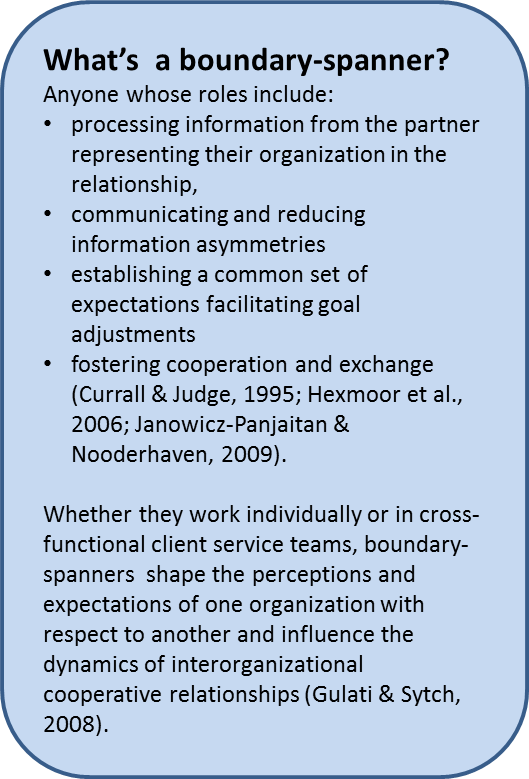
2. Who’s the boundary-spanner and what matters to them when building trust?

Now the answer becomes “it depends”. We tend to think of boundary spanners as the external-facing sales person, distributor, buyer, etc. but they can be in your legal department, in accounting, in your executive suite. Remember that inter-organizational trust is the collective trust held by the people in one organization with respect to another organization (Week 2). So it’s a combination of all the trust factors between all the people interacting in your organization with another partner –whether you’re a multi-national or a local not-for-profit.

Because boundary-spanners operate at different organizational levels and carry out different tasks, Martyna Janowicz-Panjaitan and Niels G. Noorderhaven (2006) suggest that they are also influenced by different trust factors. In their model,

  • operational-level trust” exists for operating-level boundary spanners – the people who carry out daily tasks of collaboration. Trust at this level is influenced by interpersonal factors that allay personal risks and anxieties. For example, “can I rely on my partner to deliver what I need to do my job on time?” or, more personally, “will this person let me down?
  • strategic-level trust” occurs at the more senior levels of an organization where boundary-spanners are more likely to influence overall strategic direction of the organization. Here, trust is driven more by calculation due to the role’s focus on organizational objectives.

Who are you dealing with and what matters to them?

3. What are other key factors for boundary-spanner trustworthiness or trust?

As in any relationship, trust in inter-personal business relationships can only flourish in the presence of:

  • reliability and benevolence (Jap, 1999; Hexmoor et al., 2006; Ring & Van de Ven, 1994).
  • positive attitudes toward trusting and a history of trustworthy behaviour (Currall & Judge, 1995)
  • evenhandedness, predictability, trustworthiness and benevolence (Zaheer, McEvily & Perrone, 1998).
  • honesty, openness, benevolence and general trustworthiness (Doney & Cannon, 1997)
  • expertise, likability and similarity (Doney & Cannon, 1997)
  • having the right approach

“employees seasoned in more adversarial types of projects may be unable to shift to the cooperative mode necessary to make a project alliance successful” (Laan et al., 2011, p. 106).

Boundary-spanning can be a tough job because it requires requires “constant mutual adaptation, interdependence, and joint action to create a relationship in which both parties feel high trust for the other” (Gullet et al., 2009, p. 330).

4. How does trust develop?

As we saw in Week 2, common wisdom and many scholars suggest that, as people interact and learn more about one another, trust builds and moves from calculus-based or contractual trust to knowledge-based trust which, in turn, can lead to goodwill or identification-based trust (Laan et al., 2011; McEvily, Perrone & Zaheer, 2003; Sako, 1999). For example, in their model of transformational inter-personal trust, Roy J. Lewicki, Edward C. Tomlinson and Nicole Gillespie argued that:

“Trust and distrust increase in strength (depth) and breadth (bandwidth) as a function of the frequency, duration, and diversity of experiences that either affirm confidence in positive expectations (trust) or confidence in negative expectations (distrust)” (2006, p. 1005).

However, and it’s a HUGE HOWEVER, there is an equally strong argument that  trust between boundary-spanners stems primarily from institutional factors such as roles, rules, standards and procedures, counterpart’s skills, or trust in the partner organization etc. (Bachmann, 2006; Bachmann & Inkpen, 2011; Girmscheid & Brockmann, 2010). The length of past relationship as a key factor (antecedent) for inter-organizational trust is not universally accepted, nor is it empirically supported as a factor in determining future orientation (Ganesan, 1994), supplier choice (Doney & Cannon, 1997), or inter-organizational trust (Claro et al., 2003; Currall & Judge, 195; Gulati & Sytch, 2008; Johnston et al., 2004; Sako & Helper, 1998).

In fact, two case studies from the strategic management literature found that, in the absence of preexisting institutions or history-  when there’s no time to slowly build inter-personal and inter-organizational trust through repeated interactions – joint venture partners trusted the people and groups based on their expertise, signalling, etc. (see Week 7, Part C) (Girmscheid & Brockmann, 2010).

Just as a plural governance structure – balance between formal and informal governance mechanims – holds the most promise for inter-organizational trust-building, inter-personal trust can be given quickly based on skills and governance factors. At the same time, the quality of the inter-personal relationship remains important.

“The relational quality underlying the performance…is influenced by the behaviors of the representatives of the allying organizations” (Laan et al., 2011, p.104).

5. Is inter-personal trust the basis of most IORs? Is it sufficient?

While initial relationships may spark a collaboration, in my opinion, and based on my research, inter-personal trust alone is insufficient to maximise the benefits of a partnership. Here’s why:

  • Exchange relationships must survive turnover or personality clashes (Sako & Helper,1998).
  • Research has shown that there can be a 25-month delay between the beginning of an inter-personal relationship and an impact on inter-organizational trust (Gulati & Sytch,2008). Most organizations can’t afford to wait!
  • Frequency of business contact has a positive effect on trust but social interaction is unrelated. In most business contexts the trustor places more importance on competence trust than goodwill trust (Doney & Cannon, 1997).
  • There are “no significant relationships…between the trust scales and the length of time [boundary-spanners] had known each other in any personal or work related capacity. .. trust was impacted mainly by the interactions they had in the context of their roles…” (Currall & Judge, 1995,p.165).

In other words, the “social stuff” has very little to do with building trust between organizations. Leaders may want to rethink their focus from wining and dining and focus more on presenting credentials, common goals, etc… There may also be a down-side to inter-personal relationships that are too close. For example, friendships and social ties may blur the lines of professional conduct and contribute to ethically questionable behaviour (Saini, 2010).

Most compellingly for me, however, is that

  • There is no direct impact of interpersonal relations on organizational performance (Zaheer, McEvily & Perrone, 1998) AND
  • Inter-personal boundary-spanning relationships have a limited role to play in attenuating the existing “break-down of macro-level trust in large organizations” (Bachmann & Inkpen, 2011).

The root of the Twelve Weeks to Trust series is that there is an ton of available information on inter-personal trust but that will never be sufficient to reverse the worrying trends we are seeing in gobal trust in organizations, including NGOs, media and governments. It is my hope that by paying more attention to the macro drivers of inter-organizational trust we can focus on the big levers to enable organizations to trust each other more quickly and for better results.

What do you think?

Don’t miss: Week 10: 10 Downsides to over-trust

8 Leadership Lessons from Masters Swimming

If you read this blog regularly, you know that I recently completed an MA in Leadership. The two years of reading,  writing, stress and late nights meant I spent a lot of time sitting so I re-gained a “Freshman 15” that I am trying to shed.  With this goal in mind, I joined a Masters Swim group and, in addition to dramatically improving my freestyle, have found some leadership lessons along the way.

1. Don’t be intimidated by a title. I’ve wanted to improve my stroke for quite some time but thought, erroneously, that “Masters” was for former competitive swimmers or people who had already mastered swimming. I really didn’t see myself as an athlete and didn’t think I belonged there. Had a friend not encouraged me to check it out, I might never have realized that “masters” swimming is for any adult at any level and that it is totally for people like me.

2. Everything is more difficult than it appears. Of course the Olympians make it look easy! They have dedicated their lives to mastering the sport. It’s going to take time and patience to improve. That’s the bad news. The good news is…

3. Everything can improve by breaking it down into its component parts. A great coach (see Dave at #7) will break it down for you and what seem like tiny adjustments to your hand position, how you hold your head, how you kick, etc. will make  an enormous difference. Where can you tweak other facets of your life to improve overall performance?

4. RELAX to improve your efficiency. It seems counterintuitive. We want to go faster and do more to go, well, faster but that’s not always efficient. Relaxing a bit and focusing on technique make you more efficient and help build endurance. Leadership is rarely a sprint!

5. REEEAAACH! My awesome coach Dave (see #7), suggested I watch my hand glide under the surface of the water as far as it will go before I start my “pull”. It turns out my old, fast, choppy stroke (yes, it was ugly) was leaving out at least six inches of water that I could be pulling. I was leaving “opportunity” on the table because I was trying to go too fast and I was exhausted by the effort. While I loathe the expressions “do more with less” and “work smarter, not harder” (because, quite often it just means you’ve inherited more work without resources), in this case both really do apply. I can get across the pool with fewer strokes and less energy if I relax, reach and …

6. Breathe! In the pool and in life if you don’t breathe, you drown. Enough said!

7. A great coach builds on strengths. Truly, my coach must have thought “Where do I start?” There were soooo many things I was, and am still, doing incorrectly. (Did you know it’s possible to flutter-kick or breathe incorrectly? I had no idea!) However, my great coach Dave was never critical – not once – instead, always smiling, he directed helpful suggestions to the entire group or a offered very kind individual direction like:  “Now what I want you to try is….” Instructions were very clear and, even when I didn’t get it on the first, second or third try (still trying to master the two-beat kick) he kept offering encouragement, a different approach or a modified challenge so I wouldn’t get discouraged. Mountains of thanks to Dave Lubrick from the Guelph Marlins!

8. You are never alone, even in an individual challenge. While you are working on your individual performance or endurance, someone encouraged you to start. Your teammates are there to encourage and challenge you. They too have their own stories, challenges and triumphs. Your coach provides expertise and guidance. Appreciate those around you because they all contribute to your success.

I only have a few more lessons left before we break for the summer so I wanted to say a huge Thank You to the swimmers in my group, to my coach Dave and to the Guelph Marlins! No wonder you produce Olympians – not just people who have technical expertise, but people who really BELIEVE in themselves. Thanks for extending that to me too 🙂

Sign me, a work in progress!

Dominique

Seth’s Blog: Seven marketing sins… and how they relate to brand trust

In his blog today, Seth Godin outlined  Seven marketing sins.It struck me that “selfish”, “self-absorbed” and “deceitful” are actually antonyms of goodwill or benevolence and, since trust = credibility + goodwill/benevolence, these qualities immediately harm trust in a brand. Throw in some “inconsistent” and you’ve damaged your credibility trust too – a grand slam of damaging trust in your brand. While this post was intended for consumer trust in a brand it applies to B2B marketing as well, to your ability to attract partners for joint ventures and to your ability to get the most out of that partnership.

Here’s the post from This is Seth’s Blog:

Impatient… great marketing takes time. Doing it wrong (and rushed) ten times costs much more and takes longer than doing it slowly, but right, over the same period of time.

Selfish… we have a choice, and if we sense that this is all about you, not us, our choice will be to go somewhere else.

Self-absorbed… you don’t buy from you, others buy from you. They don’t care about your business and your troubles nearly as much as you do.

Deceitful… see selfish, above. If you don’t tell us the truth, it’s probably because you’re selfish. How urgent can your needs be that you would sacrifice your future to get something now?

Inconsistent… we’re not paying that much attention, but when we do, it helps if you are similar to the voice we heard from last time.

Angry… at us? Why are you angry at us? It’s not something we want to be part of, thanks.

Jealous… is someone doing better than you? Of course they are. There’s always someone doing better than you. But if you let your jealousy change your products or your attitude or your story, we’re going to leave.

Of course, they’re not marketing sins, they’re human failings.

Humility, empathy, generosity, patience and kindness, combined with the arrogance of the brilliant inventor, are a potent alternative.