Reputation as a Source of Inter-organizational Trust — Week 8: Twelve Weeks to Trust

Experts believe that intangible assets like brand, client lists, reputation, etc.  can be worth up to one-third of a company’s market value. Why?

A solid reputation acts as a shortcut to trust – a third party (individual or an organization) acts as a “proof source” or “proxy for trust” vouching for the credibility and goodwill of an organization which is the very definition of trust (Doney & Cannon, 1997; McEvily, Perrone & Zaheer, 2003).

Reputation can attract new partners, new or expanded opportunities, new employees and it can give an organization a chance to maneuver or redeem itself if an error is made.

In inter-organizational trust, reputation is about

  • Benevolence/ Goodwill. The “extent to which firms and people in the industry believe a supplier is honest and concerned about its customers” (Doney & Cannon, 1997, p.37).
  • Capability. The extent to which a firm follows “through on promises and commitments in the general supplier community” (Dyer and Chu, 2003, p.62)

Trust and reputation are inseparable.

  • Goodwill trust is a firm’s “reputation for dealing fairly and caring about its partner firm’s welfare in alliances (Das & Teng, 2001).

So what do your partners say about your organization? Are there opportunities to improve your goodwill trust or how you follow-through on promises and commitments?

How does reputation = trust ?

In Week 2 of Twelve Weeks to Trust, we looked at how trust moves from person to group to organization and vice versa.

This transfer of trust is what makes reputation such a powerful source of information and trust.

Potential partners determine trustworthiness through “trust transfer… rather than being based on direct experience with the object of trust [firm A], initial trust impressions are based on trust in a source other than the trustee” (McEvily, Perrone & Zaheer, 2003, p.94).

The trust source can be a previous partner organization, a third-party rating of Best Employers or Top Corporate Citizens, a trade association or a network.

Think about your business network  – does it act as an information broker in your industry? Does your trade association create generally accepted norms of behaviour (Bhattacharya et al.,1998) ? Does your profession or field have “certain skills, level of competence, assets, and standards” (Das & Teng, 2001, p.275)? All of these form institutional trust to provide a minimum level of certainty that you will be a solid partner.

In case you think that cultivating a reputation for being trustworthy sounds “light” or Pollyana-ish, remember that firms guard their reputation out of calculated self-interest (Dasgupta, 1998; James, 2002). Firms are rewarded or penalized/ostracized for their behavior in the network of potential exchange partners (Axelrod, 1984; Bhattacharya et al., 1998; Das & Teng, 2001; Gulati, 1995; Hexmoor et al., 2006; Poppo & Zenger, 2002).

In their book Smart Trust, Stephen M.R. Covey and Greg Link use e-Bay as an example of how a seller’s bad reputation will turn off potential buyers and eventually lead to their expulsion from that market.

All things being equal, do you want to partner with an organization that has a stellar reputation or with one that can’t be trusted?

Don’t take my word for it. In the Journal of Economic Behaviour & Organization (a little light reading) Harvey James Sr. (2002) reviewed variations of prisoner’s dilemma games and concluded that :

“businesses that have a reputation for honest dealing will have decided advantages over those that do not have such a reputation” (James, 2002, p. 301).

The benefits of a reputation for inter-organizational trustworthiness include:

  • Improved performance (Dyer & Chu, 2003)
  • Greater credibility trust (Ganesan, 1994)
  • Greater relational governance, i.e., trust, with a specific buyer (Claro et al., 2003).
  • Lower search costs for a partner
  • Lower initial governance costs due to pre-existing trust (Gulati, 1995)

In a broader context, an organization’s reputation itself channels behaviours of, and towards, the organization in certain directions – staff behave the way the culture & reputation expects them to behave and potential partners, expecting trustworthiness, will engage in the relationship with a greater propensity to trust, more openness and less suspicion. This makes the future behaviour of the organization and their (potential) business partners more predictable, which is an important element of trustworthiness (Bachmann & Inkpen, 2011).

Yes. Reputation is a powerful mechanism for trust building. However, one note of caution on its predictive value. While reputation is used widely and is generally reliable as a proxy for trust based on direct experience – especially when it is backed up by training, certifications, past results, etc. – it is based on past actions and is not always an accurate future predictor.

In the Journal of Business Ethics (2003), Keith Blois of Oxford University examined how a changing economic context changed the way British retailer Marks & Spencer’s dealt with suppliers with whom it had enduring relationships and where deep trust existed. In his piece, Blois warns that:

Reputation cannot always predict how the other party will act in the future because contingencies cannot always be expected (Blois, 2003). He points out the important distinction between reputation built on past behaviours and trust as an expectation of future behaviour and recommends that organizations “trust but question”.

Finally, when we talk about an organization’s reputation we immediately understand the importance of the salespeople, the front-line staff or ambassadors in upholding it. That interplay between inter-personal and inter-organizational trust is our topic for Week 9 of Twelve Weeks to Trust.
Using communications to build trust – Part C of Week 7 in Twelve Weeks to Trust

Can you have inter-organizational trust without communication? No.

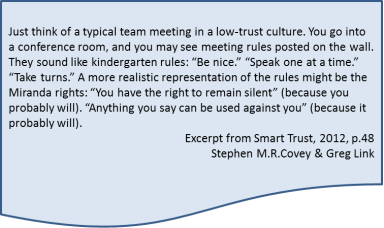
You can have an exchange of information without trust but you cannot have trust without equal, respectful, reciprocal communication.

Cynthia Hardy, Nelson Phillips & Tom Lawrence explored the role of trust in communication and the role of communication in trust. They described trust “as a process of communication” where partners build trust by creating shared meaning (1998, p.69).

Essentially, through “relevant, timely and reliable” communication, parties can understand each other’s values, perceptions and expectations – the basis of identity trust–  can be more committed to the alliance, and can engage in cooperative behaviours (Morgan & Hunt, 1994, p. 25).

The challenge is ensuring the communication happens in an environment that is free from manipulation or capitulation (Hardy et al., 1998). Otherwise, you’re back to the Covey & Link example highlighted above.

Establishing a process for two-way communication that creates shared meaning may be difficult however the benefits are significant.

Benefits of Two-way Communications:

  • Creation and sustaining of trust through a two-way flow of information which feeds on loose reciprocity over time (Bönte, 2008; Sako, 1998; Sako & Helper, 1998).
  • Creation of goodwill trust and a safeguard against opportunism through customer provision of information to the supplier. Conversely, a gap between supplier’s provision of information to customers and customers’ disclosure of information to suppliers increases customer opportunism (Sako, 1998, p.104).

Simply put, in the absence of information, people may take advantage of one another.

  • Innovation & value creation (Dyer & Chu, 2008, p.57) because

 “an interfirm knowledge-sharing routine…permits the transfer, recombination, or creation of specialized knowledge” (Dyer & Singh, 1998, p.665).

  • Creation of a virtuous cycle of trust through “transparency and keeping a common project record and administration” (Laan et al., 2011, p.106).
  • Improved performance due to open information sharing (Johnston et al., 2004).

Overcoming Communication Challenges:

Communicating to build trust can be especially challenging in cases where partners are very different. For example :

  • firm-NGO partnerships (Rivera-Santos & Rufin, 2010)
  • virtual organizations (Kasper-Fuehrer & Ashkanasy, 2001).

Here are five ways partners can overcome these challenges:

1. Establish regular communications sessions.

2. Construct common meanings through open dialogue, “language or vocabulary briefings” (Hardy et al.,1998; Janowicz-Panjaitan & Noorderhaven, 2009), development of a handbook, mutual internet site or chat room (Kasper-Fuehrer & Ashkanasy, 2001).

3. Demonstrate a commitment to truth and accuracy (Casson, 1995).

4. Use compatible communications equipment (Casson, 1995) which includes both physical and human components. Kasper-Fuehrer & Ashkanasy (2001) stress that both ‘platforms’ must be available, reliable and user-friendly in order to communicate trustworthiness (p.240).

Imagine someone telling you to ‘contact me any time’ but the technology doesn’t work or the person is never available – not exactly a sound trust-building communication strategy.

5. Signal intentionality to help a trustor determine whether your intentions are benevolent and to set the tone for the relationship when strong forms of trust have not had time to develop (Doney et al., 1998; Girmscheid & Brockmann, 2010; Hexmoor et al., 2006; Kasper-Fuehrer & Ashkanasy, 2001; Laan et al., 2011).

In their case study of a large-scale construction project, Laan et al. write:

“for trust to arise, project partners have to show that they are actually aiming for optimizing the alliance” (2011, p. 105). Therefore, the authors  encourage organizations “to adopt an attitude reflecting dedication and benevolence” (ibid., p.106).

Signalling intentionality is extremely important since perceptions of trust in the initial stages of cooperation can create a virtuous cycle of trust (Vlaar et al., 2007). Then, through common language and understanding, regular communications exchanges, reliable and timely information, and the right people and technologies, trust between organizations can flourish.

Using joint planning & joint problem solving to build inter-organizational trust – Week 7, Part B in Twelve Weeks to Trust

Goal setting, covered in Part A, is usually a part of joint planning in inter-organizational relations. It stands to reason that partners will sort out their common goals and the formal and informal governance mechanisms to achieve them. This happens through joint planning.

Joint planning :  the process of establishing partners’ roles, responsibilities, long-terms plans and contingencies, expectations, rules and procedures for sharing costs and benefits (a.k.a. distributive justice) and for resolving conflicts (a.k.a. procedural justice).

Ideally, a constructive contracting process (Week 6, Part A) covers these objectives and fosters cooperation and trust at the outset of a relationship.

Joint Planning is critical because it is

  • Strongly linked to the supplier’s trust in the buyer firm (Johnston et al.,2004).
  • A key success factor for alliances (Volery & Mensik, 1998).
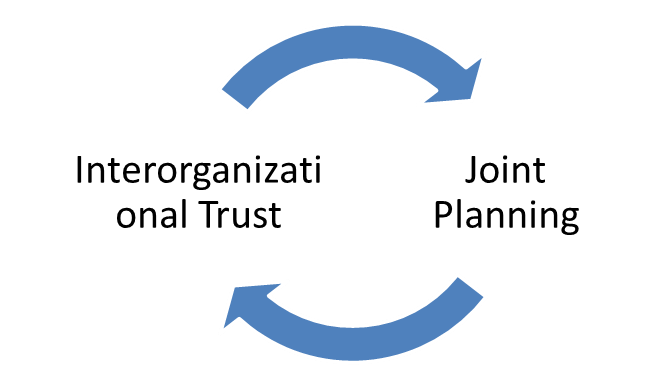
  • Capable of fostering a reciprocal and compounding relationship with inter-organizational trust that leads to improved performance.
  • Influenced by and intimately connected to physical Transaction Specific Investments (Claro et al., 2003).

Just as we have seen with other trust building mechanisms, joint planning builds inter-organizational trust which, in turn, influences joint planning which reduces transaction costs by anticipating problems & reducing monitoring (Claro et al., 2003).

Of course, in any partnership, there will be bumps in the road or unforeseen circumstances. How leaders address these challenges is critical in building and maintaining trust. It may also be a great source of innovation. Therefore, ensure that joint planning includes the creation of a fair process for joint problem solving. This is most easily done at the outset of a relationship, before any problems arise.

Remember JFK’s line?  “The best time to fix the roof is when the sun is shining.”

How powerful is joint problem solving? Repeatedly, studies show that it

  • Is a contributing factor to trust building, relational quality & consequently, better performance (Laan et al., 2011).
  • Can prevent trust deterioration – as found in a 10-year business ethics case study by Bell, Oppenheimer, & Bastien (2002).
  • Can harness “functional conflict” to build trust and create value.
  • Is a source of goodwill and competence trust (Sako, 1998).

A study by Mari Sako (1998) found that suppliers who spent more time in joint problem solving with customers have higher levels of goodwill and competence trust placed upon them.

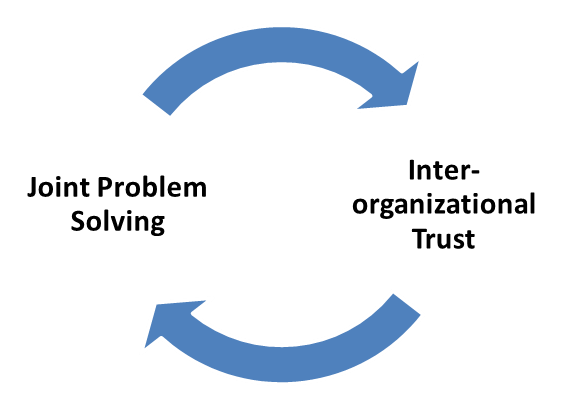
Again, we find that joint problem solving  builds trust which, in turn, fuels the mechanism… it’s the generative quality of trust we discussed in Week 2. According to Danny Pimentel Claro, Geoffrey Hagelaar & Onno Omta in their article for Industrial Marketing Management (2003), joint problem solving is solely influenced by interpersonal and inter-organizational trust, implying that inter-organizational trust is an essential element for joint problem solving (Claro et al., 2003). So, for joint problem solving to work as a trust-building mechanism, partners should ensure they meet the needs of the other party (goodwill and benevolence) and to signal these intentions very clearly.

The sooner you have the chicken and the egg, the better!

Can you have either joint planning or joint problem solving without communication? What’s this about signalling? That’s the final direct informal governance mechanism we’ll look at later this week. Til then, any questions, comments, observations?

Week 7: Using informal mechanisms to build and maintain trust – Part A: Common values, norms & goals

Trust-building governance mechanisms for inter-organizational relations

In this series we’ve examined types of trust, the benefits of high-trust partnerships, the role of goodwill in trust building and how formal governance mechanisms can foster or impede trust building. Now we turn our attention to governance by trust, a direct form of informal governance. This week, we’ll tackle relational governance in three bites: norms, values & goals; joint planning & problem solving; and bilateral communications.

Informal governance mechanisms can be divided into two streams:

  1.  Direct experience  i.e., relational governance – where you are working directly with one or many people from another organization and feed that experience back into the collective understanding of your organization; and,
  2. Indirect experience i.e., reputation – where a third person, group or organization acts as a proxy and provides information about a potential partner (Week 8).

Sometimes called governance by “goodwill trust” or a form of benevolence, relational governance has been shown by many scholars to be more efficient and less expensive than formal control mechanisms (Bachmann & Zaheer, 2008; Claro et al., 2003; Das & Teng, 2001; Dyer & Singh, 1998; Gulati, 1995; Zaheer & Venkatraman, 1995).

Think of the savings that are possible if organizations reduce or eliminate contracting costs alone! Since this is the case, firms that can rely on informal governance mechanisms to create stronger forms of trust (Week 2) have a cost-based competitive advantage over competitors who have to rely on economic hostages, contracts and supervision (Barney & Hansen, 1994, p.183).

Relational governance mechanisms include: common norms and values, goal congruence, joint planning and problem solving, and bilateral communication. All of these foster cooperation and limit opportunism (Claro et al., 2003; Poppo & Zenger, 2002; Woolthuis et al., 2005; Zaheer et al., 1998).

Each of these informal governance mechanisms can create trust on a stand-alone basis. They are also intertwined to jointly create a powerful and positive spiral of growing trust.

Common Norms & Values

While you cannot necessarily expect broad commonality in norms and values at the outset of an inter-organizational relationship – because presumably you want your partner to bring something new to the party – there is great value in selecting a partner who has similar norms & values. Barring that, you can initially focus and build on points of commonality. This is critical because:

  • Shared values are a “direct precursor of both relationship commitment and trust” (Morgan & Hunt,1994, p. 25).
  • When norms create “thick trust”, the thick trust substitutes for complete contracts and is a superior governance mechanism due to the positive ‘side effects’ of constructively solving conflicts and loyalty (Woolthuis et al.,2005).
  • Common values and norms improve exchange performance by reducing governance costs and making individual and collective behaviours more predictable thereby reducing the risk of opportunism.
  • Relational norms have “strong effects on sales growth, financial performance, cooperation and [reducing] conflict…and provide an important backdrop for other focal performance drivers” (Palmatier et al.’s, 2007, p.183).

In case you think that trust and relational governance is all a little “airy fairy” and naïve, norms also work from a punitive perspective because players who do not cooperate or follow the rules of the relationship or culture face ostracism and reduction of current & future opportunities (James, 2002). That’s a hard financial incentive to play by the rules. While this approach assumes coercion and power rather than trust, it still supports the role of norms as a strong source of internally created and imposed governance.

Goal Congruence

A number of conceptual papers, and the common knowledge, surrounding goal congruence and trust is that trust builds after numerous inter-personal interactions over time. This gives people a chance to experience goodwill, to test one another’s credibility and to deepen their understanding of one another’s role constraints – which all contribute to increased trust (Ring & Van de Ven, 1994). In an iterative approach, people develop empathy and a common-interest (identity-based trust) as they work together over time (Hexmoor et al., 2006; Lewicki et al., 2006). Trust between individuals can transfer to the group and eventually to the organization.

Convergence of values and goals lead to identity trust which, in turn, strengthens the convergence of values, attitudes and goals– a positive,  virtuous cycle (Gulati & Sytch, 2008).

However, goal congruence does not have to take time, i.e., be iterative and cumulative. This is one of Trust’s Big Myths!

In large-scale international engineering projects, contracts provide high level goals and direction and “necessitated general trust is extended to everyone even without prior knowledge” (Girmscheid & Brockmann’s, 2010, p.353). People use one another’s competencies, training and certifications (intsitutional trust) as a shortcut to extend trust. Imagine a large-scale disaster relief scenario. The various organizations don’t have the time to get to know each other slowly and build common values, norms and goals over time, they have to go on competencies and common objectives.

Whether iterative or instant, common goals …

  • Set the direction of the alliance (Das & Teng, 2001).
  • Limit distrust (Sako & Helper, 1998)
  • Evoke sentiments most strongly related to trust (Geyskens et al.’,1998)
  • Have a significant positive effect on coordination efforts within Inter-organizational relations (IORs) (Jap, 1999)
  • Are an important variable in the success of alliances (Volery & Mensik, 1998)
  • Meet the fundamental business ethics requirement that “both organization and individual needs will be achieved best by pursuing collective ends (Hosmer, 1996; Caldwell & Karri, 2005).

It’s not about singing kumba-ya… it’s a solid business strategy that ensures that goals and outcomes are clear. With a literally down-to-earth observation, a respondent in a case study of large-scale construction projects stated:

 “There has to be a common interest, so that if a project partner screws up the project he also spoils it for himself” (Laan et al., 2011, p.104).

Do you have experience with swift trust between organizations? How about a scenario where goals were not aligned in a business partnership? How did you realign the situation? I’d love to hear about it.

I hope to see you at Part B when we explore Joint Planning and Problem Solving as informal relational governance mechanisms.